Pathogenesis, Epidemiology thiab Kev Tswj Xyuas Pab Pawg A Streptococcus Kab Mob
Oct 09, 2023
Streptococcus pyogenes muaj(Pab AStreptococcus; GAS) tau txais txiaj ntsig zoo rau tib neeg tus tswv tsev, ua rau muaj kab mob asymptomatic, pharyngitis, pyoderma, kub taub hau, lossis kab mob sib kis, nrog rau qhov muaj peev xwm ua rau muaj kev tiv thaiv kab mob tom qab kis kab mob. GAS siv ntau yam kev ua phem rau kev txiav txim siab kom tso cai rau kev ua lag luam, kev tshaj tawm hauv tus tswv tsev, thiab kev sib kis, cuam tshuam ob qho tib si hauv lub cev thiab kev tiv thaiv kab mob tiv thaiv kab mob. Kev hloov pauv thoob ntiaj teb GAS kev kis mob yog tus cwj pwm los ntawm qhov tshwm sim ntawm GAS tshiab clones, feem ntau cuam tshuam nrog kev nrhiav tau ntawm cov kab mob tshiab lossis tshuaj tiv thaiv kab mob uas tau hloov kho kom zoo dua rau cov kab mob niche lossis tiv thaiv tus tswv tsev tiv thaiv. Lub tswv yim tsis ntev los nontification ntawm chaw kho mob GAS cais nrog txo penicillin rhiab heev thiab ua rau macrolide kuj hem ob leeg frontline thiab penicillin-adjunctive tshuaj tua kab mob. Lub Koom Haum Saib Xyuas Kev Noj Qab Haus Huv Ntiaj Teb (WHO) tau tsim GAS kev tshawb fawb thiab thev naus laus zis txoj hauv kev thiab tau piav qhia txog cov yam ntxwv ntawm cov tshuaj tiv thaiv uas nyiam, txhawb kev xav rov qab los ntawm kev tsim cov tshuaj tiv thaiv GAS muaj kev nyab xeeb thiab zoo.

Suav tshuaj ntsuab cistanche cog-Antitumor
Taw qhia
Streptococcus pyogenes (Group A Streptococcus; GAS) yog Gram-positive host-adapted bacterial pathogens ua rau tib neeg kis kab mob xws li pharyngitis thiab impetigo, mus txog rau cov kab mob tsis tshua muaj mob hnyav xws li septicemia, streptococcal toxic shock-like syndrome (STSS) thiab necrotizing fasciitis. Cov kab mob GAS rov ua dua tuaj yeem ua rau autoimmune sequelae suav nrog rheumatic fever uas tuaj yeem ua rau mob rheumatic heart disease (RHD)1. Epidemiologically, GAS tuaj yeem muab faib ua ntau tshaj 220 mm hom 2 (raws li cov noob caj noob ces ntawm cov amino-terminal ntawm qhov nto-exposed M protein) uas qhia txawv cov qauv ntawm cheeb tsam thiab thoob ntiaj teb kev faib tawm3. Kev tshawb nrhiav kev kis mob tsis ntev los no tau tshawb pom ntau tus kab mob npaws liab liab hauv Asia thiab United Kingdom 4-7, nrog rau UK tus kab mob sib kis tau nce mus rau qhov kis kab mob 4. Raws li tus tswv tsev hloov kho tib neeg cov kab mob, GAS ciaj sia yuav tsum muaj lub voj voog tsis sib haum xeeb ntawm kev sib kis, ua raws li qhov chaw kis kab mob tseem ceeb (dawb tawv nqaij lossis caj pas), colonization thiab proliferation, tiv thaiv ob qho tib si hauv lub cev thiab kev tiv thaiv kab mob, thiab kev nthuav tawm tom ntej mus rau tus tswv tsev tshiab. Cov tswv yim tiv thaiv kab mob tshiab tau ua haujlwm los ntawm GAS los tswj hwm cov tswv cuab tiv thaiv tau raug tshawb pom. Piv txwv li, qhov cleavage ntawm Gasdermin A (GSDMA) los ntawm GAS protease streptococcal pyrogenic exotoxin B (SpeB) tau pom tias ua rau tus tswv tsev cell pyroptosis8,9, whereas mucosal-associated invariant T cells (MAIT cells) tau raug txheeb xyuas tsis ntev los no. activated nyob rau hauv cov neeg mob nrog STSS, thiab ua tus thawj contributors rau lub cytokine cua daj cua dub txuam nrog tus kab mob no10. Thaum tsis muaj cov tshuaj tiv thaiv GAS ua lag luam, kev cuam tshuam kev kho mob tawm tsam GAS yog nyob ntawm kev siv tshuaj tua kab mob los kho lossis tiv thaiv kab mob. Txawm li cas los xij, GAS cov tshuaj tiv thaiv kab mob tau nce zuj zus thiab thawj qhov kev hloov pauv uas txo qis penicillin rhiab heev tau raug tshaj tawm 11-15; Txawm li cas los xij, GAS tseem raug rau -lactam tshuaj tua kab mob. Txhawm rau txhawm rau txhim kho GAS tshuaj tiv thaiv sai, Lub Koom Haum Saib Xyuas Kev Noj Qab Haus Huv Ntiaj Teb (WHO) tau tsim GAS tshawb fawb thiab kev siv thev naus laus zis thiab tau piav qhia txog cov yam ntxwv ntawm cov khoom lag luam nyiam 16. Cov genomics loj tau siv los txheeb xyuas cov qauv GAS thoob ntiaj teb cov pej xeem thiab kwv yees cov tshuaj tiv thaiv antigen17. Cov tshuaj tiv thaiv GAS tshiab qhia tawm tsam M protein thiab tsis-M protein antigens yog nyob rau hauv kev loj hlob18. Tus qauv uas tsis yog tib neeg primate ntawm GAS pharyn gitis tsis ntev los no tau siv los ntsuas GAS tshuaj tiv thaiv kev ua tau zoo19, thiab kev txhim kho ntawm tus qauv tswj tib neeg tus kab mob (CHIM) ntawm GAS pharyngitis20 muab lub sijhawm yav tom ntej rau kev ntsuas tshuaj tiv thaiv zoo hauv tib neeg tus tswv tsev. Xyoo kaum xyoo dhau los tau pom qhov kev vam meej loj hauv kev tshawb fawb GAS, tab sis txawm tias nrog kev txhim kho txuas ntxiv ntawm cov qauv kev sim tshiab thiab cov tswv yim kho mob, kev siv tshuaj tiv thaiv rov qab los, thiab kev mob siab rau kev soj ntsuam, lub nra thoob ntiaj teb ntawm GAS cov kab mob tseem tsis tau ntsib pej xeem. kev nyuaj siab. Qhov tshwm sim thiab kev tshaj tawm ntawm ob hom tshuaj tiv thaiv kab mob ntau yam thiab cov tshuaj toxigenic GAS clones tshiab qhia txog qhov kev xav tau ceev los txhim kho cov tswv yim kev noj qab haus huv rau pej xeem los tiv thaiv lossis kho tib neeg GAS kab mob. Raws li hais txog tag nrho cov kab mob sib kis, kev kho mob, thiab molecular yam ntawm GAS kab mob yog dhau ntawm qhov Kev Ntsuam Xyuas no, ntawm no peb tsom mus rau cov kev tshawb fawb tshiab tshaj plaws thiab kev nce qib.
Kab mob tshwm sim los ntawm GAS
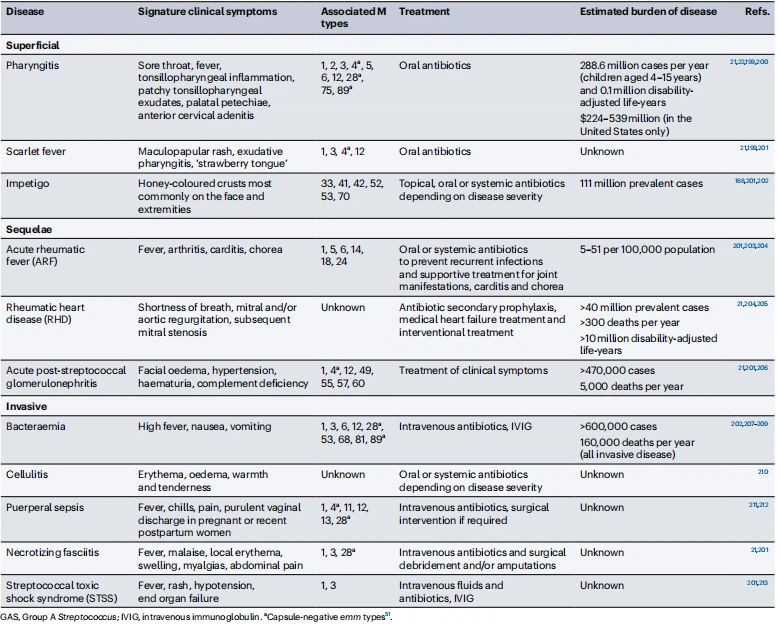
Raws li ib tug exquisitely tib neeg-hloov cov kab mob, GAS tuaj yeem ua rau muaj ntau yam kab mob tshwm sim. Table 1 piav qhia txog cov kab mob feem ntau cuam tshuam nrog GAS, tab sis lwm yam kab mob uas muaj xws li otitis media, sinusitis, meningitis, endocarditis, pneumonia, peritonitis, thiab osteomyelitis1. Nws kwv yees tias GAS suav txog ib nrab lab tus neeg tuag txhua xyoo, nrog RHD thiab kis kab mob ua rau muaj feem ntau ntawm cov neeg tuag21. Kev kwv yees tsis ntev los no tau hais txog lub nra hnyav rau kev noj qab haus huv uas tshwm sim los ntawm GAS kab mob, qhia tias RHD yog lub luag haujlwm rau ntau dua 100 lab kev xiam oob qhab-hloov lub neej-xyoo nrog 0.1% raug ntaus nqi los ntawm GAS pharyngitis hauv cov menyuam yaus22. Cov kev kwv yees no tsis tau txiav txim siab rau lwm yam kab mob GAS, thiab cov ntaub ntawv kis mob, tshwj xeeb hauv cov tebchaws tau nyiaj tsawg thiab nruab nrab, tseem tsis tshua muaj. Cov kev tshawb fawb los ntawm Australia thiab New Zealand qhia tias cellulitis yog lub luag haujlwm rau kev noj qab haus huv thiab kev lag luam siab tshaj plaws ntawm tag nrho cov kab mob GAS hauv cov chaw no23, txawm tias saum RHD. Ua ke, kev kwv yees thoob ntiaj teb rau kev noj qab haus huv thiab kev lag luam ntawm tag nrho cov kab mob ntsig txog GAS tseem nkag siab tsis zoo, qhia txog qhov xav tau ceev kom muaj lub nra zoo dua ntawm cov ntaub ntawv kab mob txhawm rau nkag siab qhov cuam tshuam ntawm cov kab mob no thoob ntiaj teb. Tshaj li kaum xyoo dhau los, ib qho kev tawm tswv yim tseem ceeb los ntawm WHO tau tsa kev paub txog RHD thiab nws txoj kev koom tes rau lub ntiaj teb lub nra ntawm tus kab mob, thiab kev sib sib zog nqus ntawm kev sib raug zoo nyob rau hauv cov neeg tsis muaj zog uas twb muaj lawm 24,25. Tsis tas li ntawd, kev tshawb fawb los ntawm Tebchaws Meskas thiab Ixayees tau hais tias RHD tseem yog ib qho teeb meem tseem ceeb rau pej xeem kev noj qab haus huv txawm tias nyob hauv cov tebchaws tau nyiaj ntau26. Txawm li cas los xij, tseem muaj qhov sib txawv tseem ceeb hauv peb txoj kev paub txog tus kab mob no. Kev tshawb fawb tau txuas ntxiv los tsim cov pov thawj muaj zog uas txhawb nqa qhov kev xav ntawm kev sib txuas ntawm cov kab mob ntawm daim tawv nqaij thiab kev loj hlob ntawm kev tiv thaiv kab mob sequelae27,28. Scarlet fever, ib tug kab mob uas tau xyaum ploj mus los ntawm qhov kawg ntawm lub xyoo pua nees nkaum, tau rov tshwm sim tsis ntev los no nrog cov kab mob tshwm sim hauv Suav teb, Hong Kong, Kaus Lim Qab Teb, Singapore, thiab United Kingdom4,5,29–31. Txog niaj hnub no, cov kab mob tshwm sim feem ntau yog cov kab mob sib kis thiab txuas nrog cov cim kab mob sib kis xws li kev thauj mus los ntawm cov noob caj noob ces uas muaj exotoxins thiab muab cov tshuaj tiv thaiv ntau rau tetracycline thiab macrolides6, tshwj xeeb hauv Asia. Scarlet fever-zoo li kis kab mob clones kuj tau kuaj pom nyob rau hauv ob peb lwm thaj chaw hauv cheeb tsam32,33. Nws tseem ceeb heev kom muaj kev nkag tau mus rau qhov zoo dua hauv zos thiab thoob ntiaj teb kev soj ntsuam cov kab mob rau kev taug qab GAS cov kab mob, muab cov kev tshawb fawb tau pom tias cov neeg mob uas muaj kab mob me me yuav muaj kev pheej hmoo ntau dua ntawm kev kis kab mob 34. Tsis tas li ntawd, ib qho kev nce ntxiv ntawm qhov tshwm sim ntawm tus kab mob GAS tau raug sau tseg hauv ntau lub tebchaws, tshwj xeeb tshaj yog nyob rau hauv cov neeg txom nyem thiab cov neeg tsis muaj zog 4,35-37, rov hais dua qhov tseem ceeb ntawm kev saib xyuas GAS kab mob sib kis. Nws yuav tsum raug sau tseg tias kev txhim kho hauv nruab nrab ntawm cov kev qhia txog kev noj qab haus huv kuj tseem tuaj yeem ua rau pom qhov nce ntxiv.
cistanche ntxiv cov txiaj ntsig-yuav ua li cas ntxiv dag zog rau lub cev
GAS kab mob, virulence yam, thiab mechanisms
Cov txheej txheem ntawm tib neeg tus kab mob los ntawm GAS yog complex thiab multifactorial, koom nrog ob tus tswv tsev thiab cov kab mob uas ua rau cov kab mob ntawm cov kab mob. GAS ua rau muaj ntau ntawm cov cell phab ntsa-txuas thiab secreted virulence yam tseem ceeb uas muaj ntau yam cuam tshuam rau cov ntaub so ntswg, hlwb, thiab cov khoom ntawm lub cev tiv thaiv kab mob (Daim duab 1), uas tau nthuav dav tshuaj xyuas lwm qhov1. Ntawm no, peb tsom mus rau qhov tseem ceeb virulence yam tseem ceeb rau kev colonization ntawm cov ntaub so ntswg epithelial thiab kev loj hlob ntawm tus kab mob invasive, qhia txog qhov kev nce qib tsis ntev los no hauv cheeb tsam no.
Nto-bound virulence factor
M protein. GAS yog cais raws li qhov sib lawv liag ntawm 5' kawg ntawm cov noob encoding M protein (mm). Ntau tshaj 220 mm genotypes tau txheeb xyuas2. M protein yog dimeric coiled-coil fibrillar protein uas txuas los ntawm cov kab mob cell phab ntsa 38. Nws muaj ib tug conserved carboxy-terminal uas confers covalent txuas ntawm M protein rau phab ntsa ntawm tes thiab ib tug hypervariable nto-exposed N terminal uas muaj cov M hom-txhais tau 50 amino acids, uas nthuav tawm ntau yam antigenic ntau haiv neeg39. Kev koom tes ntawm M proteins rau GAS virulence feem ntau yog los ntawm lawv cov kev tiv thaiv kab mob-modulatory. Lawv tuaj yeem khi ncaj qha rau thiab nrhiav ntau tus tswv tsev, suav nrog plasmin (ogen) thiab fibrinogen, mus rau qhov chaw streptococcal, yog li sib tham txog kev tiv thaiv hauv lub cev thiab hloov lub cev tiv thaiv kab mob 1. M cov proteins kuj ua rau cov txheej txheem cell tuag hauv macrophages los ntawm inducing NLRP3 inflammasome machinery, ua rau kev ua thiab tso tawm ntawm cov pro-inflammatory cytokines interleukin -1 (IL-1) thiab IL-18 ( refs. 40,41), txawm hais tias nyob rau hauv M hom tshwj xeeb. Ntau cov kev tshawb fawb tau muab pov thawj tias M cov proteins kuj tseem ua rau muaj kev sib koom ua ke los ntawm kev sib txuas nrog cov kab mob ntawm cov epithelial cell receptors, xws li membrane cofactor protein (MCP; tseem hu ua CD46) 42 thiab cell-surface glycans43,44, txawm hais tias serotype-specific sib txawv hauv Cov kev sib cuam tshuam no tau tshaj tawm 45.
Table 1|Kab mob tshwm sim los ntawm GAS kab mob
Hyaluronic acid capsule muaj.
Lub hyaluronic acid capsule ntawm GAS yog tsim los ntawm rov qab disaccharide units ntawm glucuronic acid thiab N-acetylglu cocaine thiab confers tus yam ntxwv ntub mucoid colony morphology. GAS capsule yog structurally zoo tib yam rau tib neeg hyaluronic acid, ib feem tseem ceeb ntawm extracellular matrices pom nyob rau hauv ntau lub cev nqaij daim tawv nrog rau connective thiab epithelial cov ntaub so ntswg. GAS capsule yog li ua rau camouflage tus kab mob los ntawm tus tswv tsev tiv thaiv kab mob. Los ntawm kev khi ncaj qha rau tib neeg lub xov tooj ntawm tes glycoprotein CD44, thawj receptor rau tib neeg hyaluronic acid46, GAS capsule mediates adherence rau epithelial hlwb ntawm pharynx thiab tawv nqaij47. CD44-nyob ruaj khov txuas ntxiv ua rau kev ua haujlwm ntawm cov xov tooj ntawm tes taw qhia txoj hauv kev uas cuam tshuam qhov cuam tshuam ntawm epithelial barrier kev ncaj ncees, yog li tso cai rau GAS nkag mus rau hauv cov ntaub so ntswg tob 47. GAS encapsulation kuj tau pom tias yuav ua rau muaj kev phom sij ntxiv thiab tiv thaiv kom muaj kev sib haum xeeb phagocytic tua48. Txawm li cas los xij, kev poob ntawm cov tshuaj ntsiav tau raug tshaj tawm nyob rau hauv ob qho tib si tawm tsam thiab tsis muaj kab mob los ntawm ntau hom sib txawv uas tsis muaj tag nrho cov tshuaj muaj ABC capsule gene operon (emm4, emm22, thiab emm89) 49,50 lossis chaw nres nkoj inactivating mutations nyob rau hauv cov noob caj noob ces ( em28 thiab 87) 51,52. Qhov kev xaiv zoo dua los ntawm kev poob qis hauv cov keeb kwm caj ces no tsis nkag siab tag nrho.

Daim duab 1|GAS virulence yam thiab lawv lub luag haujlwm hauv cell adherence, ntxeem tau, thiab tiv thaiv kab mob. ib,
S protein.
GAS tau hloov kho ntau lub tswv yim ingenious kom tsis txhob muaj kev tiv thaiv kab mob. Ib daim ntawv tshiab ntawm molecular mimicry tsis ntev los no tau piav qhia, nyob rau hauv uas muaj kev tiv thaiv zoo heev ntawm cov protein (S protein) tau pom tias xaiv khi rau cov ntshav liab membranes53. S protein-dependent membrane txheej ntawm GAS cell nto tiv thaiv phagocytic tua, muab ib qho kev sib txuas tseem ceeb ntawm cov yam ntxwv hemolytic kev ua ntawm cov kab mob no thiab lub zog tiv thaiv kab mob uas yuav pab txhawb kev ciaj sia ntawm cov ntshav thiab kev nthuav tawm.
Secreted virulence yam
Chemokine degradation. Proteases yog siv los ntawm cov kab mob pathogenic rau tshwj xeeb cleave thiab neutralize cov cim tseem ceeb ntawm cov kab mob hauv lub cev 54. GAS secretes ob yam proteases hu ua S. pyogenes cell envelope proteinase (SpyCEP) thiab C5a peptidase (ScpA) uas tshem cov chemokine IL-8 (tseem hu ua C–X–C motif chemokine ligand 8 (CXCL8)) thiab ntxiv tivthaiv 5a (C5a), feem 55,56. Cleavage ntawm cov tshuaj muaj zog chemoattractants impairs neutrophil infiltration thiab activation, ib qho tseem ceeb tiv thaiv mechanism ntawm innate tiv thaiv.

cistanche ntxiv cov txiaj ntsig-nce kev tiv thaiv
Deoxyribonucleases.
Ntau yam kab mob streptococci tsim tawm cov cellular deoxyribonucleases (DNases) los tawm tsam tus tswv tsev tiv thaiv kab mob57. Tag nrho cov kab mob GAS sib txuas muaj tsawg kawg yog ib qho ntxiv DNase58. Nyob rau hauv tag nrho, rau prophage-encoded (sda1, sda2, spd1, spd3, spd4, thiab sdn) thiab ob chromosome-encoded (spnA thiab spdB) DNase noob tau txheeb xyuas hauv GAS57. Ntawm cov no, SpnA yog tib lub xov tooj ntawm tes-nplaum DNase uas muaj qhov tsim nyog sortase substrate LPXTG motif59. Lub luag haujlwm tseem ceeb ntawm streptococcal DNases tshwm sim yog qhov degradation ntawm DNA lub moj khaum ntawm neutrophil extracellular ntxiab (NETs) pab txhawb kev tso tawm cov kab mob nkag mus rau 60-62, thiab autodegradation ntawm cov kab mob DNA, yog li suppressing TLR9- nyob ntawm kev paub los ntawm lub cev tiv thaiv kab mob63 . Cov txiaj ntsig tau los ntawm ntau tus qauv kab mob qhia tias lub luag haujlwm tseem ceeb rau DNases hauv pathogenesis ntawm GAS tus kab mob 60-62.
Streptokinase.
Streptokinase (SK) yog ib qho muaj zog ntawm tib neeg tshwj xeeb plasminogen-activating protein. Tsis zoo li lwm cov plasminogen activators, SK tsis muaj kev ua haujlwm hauv lub cev. Lub SK-plasminogen complex muaj plasmin zoo li kev ua haujlwm thiab tseem ceeb heev rau cov kab mob ntawm cov kab mob GAS, pab kev sib kis ntawm cov kab mob los ntawm kev tiv thaiv kev tiv thaiv tus tswv tsev proteins 64-67.
Immunoglobulin-degrading enzymes.
Txhawm rau tiv thaiv kev tiv thaiv kab mob, GAS zais peb lub immunoglobulin-degrading enzymes, hu ua IdeS/Mac-1, Mac-2, thiab EndoS, uas tshwj xeeb tsom opsonizing IgG cov tshuaj tiv thaiv. IdeS yog ib qho cysteine protease uas ua rau cov saw hnyav ntawm IgG68. Mac-2 yog ib qho allelic variant ntawm IdeS nrog cov haujlwm IgG endopeptidase zoo sib xws. Ob leeg cov proteins ua haujlwm li IgG endopeptidases; Txawm li cas los xij, lawv kuj cuam tshuam nrog Fc receptors ntawm phagocytic hlwb, yog li cuam tshuam nrog Fc-mediated host defense mechanisms. EndoS, los ntawm qhov sib txawv, muaj cov haujlwm endoglycosidase thiab tshwj xeeb yog hydrolyses core glycans ntawm tib neeg IgG cov tshuaj tiv thaiv, ua rau cov tshuaj tiv thaiv kab mob ua haujlwm tsis zoo thaum kis kab mob70.
SpeB. Qhov dav substrate tshwj xeeb ntawm SpeB ua rau kev sib cais ntawm ntau tus tswv tsev thiab cov kab mob cov kab mob, nrog rau cov kab mob intercellular barrier proteins ntawm epithelial junctions71, party extracellular matrix proteins72, ntxiv cov ntsiab lus 73, cathelicidin-derived antimicrobial peptide LL.-37 (ref. 74), autophagy Cheebtsam75 thiab chemokines76. SpeB kuj qhia txog cov khoom tiv thaiv kab mob los ntawm kev ncaj qha cleaving thiab ua kom cov precursors ntawm IL-1 (ref. 77) thiab epithelial IL-36 (ref. 78), ob lub zog pro-inflammatory cytokines uas tseem ceeb rau tus tswv tsev tiv thaiv teb rau kev kis kab mob thiab raug mob. Lwm qhov tsis ntev los no tau pom cov txheej txheem proinflammatory cuam tshuam nrog kev sib cais thiab ua kom lub pore-forming GSDMA hauv cov tawv nqaij epithelial hlwb uas ua rau pyroptosis, lytic daim ntawv ntawm inflammatory cell tuag8,9. Caspase-independent cleavage ntawm GSDMA los ntawm SpeB yog kev xaiv heev thiab xav kom SpeB nkag mus rau cytosol ntawm cov kab mob. Intriguingly, txawm hais tias SpeB yuav tsum tau nyob rau hauv cov theem pib ntawm tus kab mob, SpeB-negative variants feem ntau tshwm sim los ntawm kev tiv thaiv kab mob thaum kis mob hnyav nyob rau hauv M1T1 GAS79-81 thiab, rau ib tug tsawg dua, nyob rau hauv tsis-M1 GAS82. Kev poob ntawm SpeB kev qhia raws li qhov tshwm sim ntawm kev hloov pauv hauv covR/S kev tswj hwm qhov system ua rau muaj kev cuam tshuam ntawm cov dej-txheej plasmin kev ua haujlwm uas ua rau muaj kev sib kis ntawm GAS hauv vivo83.
Streptolysins thiab NAD glycohydrolase. Yuav luag txhua qhov chaw kho mob cais ntawm GAS zais ob lub zog cytolytic co toxins, streptolysin S (SLS) thiab streptolysin O (SLO), uas ua rau cov pore tsim hauv eukaryotic cell membranes. Ob leeg cytolysins yog cytotoxic tawm tsam ntau yam ntawm cov tswv tsev, nrog rau cov kab mob epithelial thiab lub cev tsis muaj zog. Ntau lub luag haujlwm tau raug xa mus rau SLS thiab SLO, xws li los ntawm cov ntaub so ntswg puas, kev cuam tshuam cov ntaub so ntswg, thiab kev tiv thaiv kab mob hauv lub cev mus rau kev ua kom cov lus teb tiv thaiv-88. Lub paj hlwb peripheral yog lwm lub hom phiaj tshwj xeeb rau SLS, uas ua rau muaj kev hnov mob neurons los tsim qhov mob thiab ua rau cov neeg ua haujlwm ntawm lub cev tiv thaiv kab mob, txhawb cov kab mob ciaj sia thaum kis kab mob89. Hauv GAS, kev ua haujlwm ntawm cov roj cholesterol-dependent cytolysin SLO yog ua haujlwm cuam tshuam nrog cov co-expressed toxin NAD glycohydrolase (NADase; tseem hu ua SPN lossis NGA) 90, uas depletes host cell ntawm cellular zog khw91. SLO thiab NADase lub cev sib cuam tshuam thiab ua haujlwm ruaj khov tom qab tso tawm 92. NADase-dependent membrane binding txhawb nqa qhov pore tsim los ntawm SLO93, uas cuam tshuam rau kev hloov pauv ntawm NADase rau hauv cov tswv tsev cell94. Hauv kev sib xyaw ua ke, SLO thiab nws cov co-toxin NADase txhawb nqa GAS intracellular ciaj sia taus thiab cytotoxicity hauv macrophages thiab epithelial cells95,96, cuam tshuam tus tswv tsev tiv thaiv hauv cov xov tooj ntawm tes los ntawm Golgi fragmentation97, thiab pab txhawb rau pathogenesis hauv vivo98. Streptococcal strain tshwm sim thiab kev sib kis tau cuam tshuam nrog kev ua haujlwm siab txhawb nqa kev sib koom ua ke ntawm NADase-SLO locus uas ua rau muaj kev nthuav qhia ntau ntxiv ntawm NADase thiab SLO toxins50,52,99,100. Qhov kev hloov pauv ntawm cov genome recombination no feem ntau pom nyob rau hauv acapsular isolates, qhia tias cov tshuaj ntsiav ntau lawm tuaj yeem siv tau rau hauv cov tshuaj lom neeg uas nthuav tawm ntau tshaj 50,52,100, tab sis lub hauv paus txheej txheem rau kev sib raug zoo no tseem yuav txiav txim siab.
cistanche cov txiaj ntsig rau txiv neej-ua kom muaj zog tiv thaiv kab mob
Superantigens. Superantigens, tseem hu ua Spes, yog cov muaj zog exotoxins uas hla thaj tsam sib txawv ntawm T cell receptor -chains (TCR V) nrog MHC class II molecules ntawm antigen-presenting cells (APCs) hauv qhov tsis yog-antigen-specific yam, ua rau Hauv kev ua kom dav dav ntawm T hlwb thiab kev tswj tsis tau cytokine cov lus teb 101. Streptococcal superantigens tau cuam tshuam rau ntau yam ntawm tib neeg cov kab mob, feem ntau tshwj xeeb tshaj yog mob toxic shock syndrome thiab scarlet fever101. Txog niaj hnub no, 13 qhov txawv superantigens tau txheeb xyuas hauv GAS (chromosome-encoded: speG, speJ, speQ, speR, thiab smeZ; prophage-encoded: speA, speC, speH, speI, speK–M thiab 2 ssa, ntawm no). peb tus superantigens (SpeA, SpeC, thiab SSA) tau txuas nrog kev ua kom lub cev muaj zog thiab kev ua phem ntawm cov kab mob GAS tam sim no ua rau kub taub hau thiab kab mob 4,61,103. Kev nce qib tseem ceeb tau ua tiav hauv thaj chaw ntawm superantigen biology siv cov nas transgenic uas qhia txog tib neeg leukocyte antigen (HLA) MHC chav kawm II molecules ua tus qauv superantigen-rhiab kab mob, uas tau pab tsim lub luag haujlwm tseem ceeb rau SpeA thiab SpeC hauv kev mob nasopharyngeal kis los ntawm GAS61. Ib., 103, 104.
Host teb rau GAS kab mob
Raws li tib neeg txwv tsis pub muaj kab mob, tsiaj cov qauv ntawm GAS cov kab mob sib koom ua ke nrog tib neeg cov kab mob, uas yog qhov cuam tshuam rau kev tshawb fawb txog kev tiv thaiv kab mob. A CHIM rau GAS pharyngitis tsis ntev los no tau tsim, uas muab lub sijhawm tsis sib xws los nug cov xovtooj ntawm tes thiab kev lom zem uas ua rau tib neeg lub cev tiv thaiv kab mob thaum ntxov rau GAS kab mob 20,105. Kev soj ntsuam ntawm sera sau los ntawm CHIM cov neeg tuaj yeem pab dawb tau qhia tias cov lus teb thaum ntxov yog tus cwj pwm los ntawm kev nce siab ntawm IFN , IL-6, CXCL10, thiab IL-1Ra saum toj no hauv paus 105. Qhov no tau cuam tshuam nrog kev nce ntxiv hauv IL-1Ra, IL-6, IFN , thiab IP-10 saum toj no hauv paus kab hauv cov qaub ncaug ntawm cov neeg mob uas tsim mob pharyngitis, uas tsis tshua muaj tshwm sim hauv cov neeg mob uas tseem tsis muaj tsos mob. Qhov siab ntawm cov cytokines pro-inflammatory tau cuam tshuam nrog ntau ntawm cov monocytes thiab dendritic hlwb, thiab los ntawm kev txo qis hauv cov pa CD4+ T cells (T follicular helper cells, T helper 17 cells (TH17 cells), TH1 cells) thiab B hlwb hauv cov ntshav, nrog rau kev nthuav tawm cov cim ua kom pom los ntawm δT hlwb. Kev nrhiav neeg ua haujlwm sai ntawm T follicular pab hlwb thiab B hlwb mus rau qhov chaw kis kab mob hauv CHIM tau pom zoo nrog qhov kev tshawb pom tias tonsillitis rov tshwm sim yog ib qho kab mob tiv thaiv kab mob cuam tshuam nrog T follicular helper cell thiab B cell ua haujlwm. Critically, MAIT hlwb tau qhib tom qab kis tau rau GAS, thiab IL-18, uas activates MAIT hlwb, tau nce siab nyob rau hauv cov qaub ncaug ntawm cov kev xeem, uas tsis tau qhia los ntawm kev tshawb fawb siv nas qauv ntawm nasopharyngeal kab mob.
MAIT cells
Qhia txog qhov yuav tsum tau ua tib zoo txhais cov lus pom zoo uas tau txais los ntawm cov qauv nas ntawm GAS kab mob, MAIT hlwb tsis tau ua kom pom tseeb hauv cov ntsiab lus ntawm GAS kab mob. Tsis tas li ntawd, murine MAIT hlwb tau pib qhia tias tsis tau ua haujlwm los ntawm GAS107 thaum tib neeg MAIT hlwb tau qhib los ntawm GAS ntawm ob txoj kev sib txawv 10,108,109. MAIT cov hlwb tsis ntev los no tau pom tias muaj kev ua haujlwm siab heev hauv cov neeg mob STSS thiab tau txheeb xyuas tias yog thawj koom nrog rau lub koom haum cytokine cua daj cua dub nrog tus kab mob no10. Txawm hais tias sawv cev tsuas yog 1-10% ntawm cov ntshav peripheral T cell cov pej xeem, thaum ex vivo stimulation ntawm peripheral ntshav mononuclear hlwb los ntawm cov neeg mob STSS nrog GAS, MAIT hlwb sawv cev 41% ntawm IFN -producing thiab 15% ntawm TNF tsim T hlwb, feem. . Hauv qee cov neeg mob, MAIT hlwb sawv cev ze li ntawm 60% ntawm IFN - tsim T-cells10, thiab depletion ntawm MAIT hlwb los ntawm peripheral ntshav mononuclear hlwb ua ntej stimulation nrog GAS txo cov zus tau tej cov IFN , IL-1 , IL{{15 } }, thiab TNF, uas tsav immunopathology thaum lub sij hawm STSS cytokine storm110. Ib yam li ntawd, MAIT hlwb tau nce siab hauv cov ntshav ntawm cov neeg mob uas muaj mob rheumatic fever (ARF) thiab hauv cov neeg uas nyuam qhuav tawm hauv tsev kho mob vim ARF, piv nrog cov neeg noj qab haus huv111. Tsis tas li ntawd, MAIT hlwb los ntawm cov neeg mob nrog ARF nthuav tawm ntau dua IFN thiab TNF ntau dua li cov tau txais los ntawm cov tib neeg noj qab haus huv, uas yuav pab txhawb rau immunopathology112,113. Cov kev soj ntsuam no tau ua raws li qhov kev tshwm sim tshwm sim uas qhia tias MAIT cov hlwb ua lub luag haujlwm tseem ceeb hauv lwm cov kab mob autoimmune nrog rau hom 1 diabetes114, ankylosing spondylotitis115, thiab inflammatory plob tsis so tswj kab mob116. Ua ke, cov kev tshawb pom no cuam tshuam rau MAIT cov hlwb hauv cov kab mob ntawm pharyngitis, invasive GAS, thiab ARF (Fig. 2), thiab txawm hais tias nws tseem muaj kev xav, nws yog kev ntxias kom xav tias cov kev kho mob uas xaiv tsis zoo MAIT cell kev ua yuav muaj kev siv dav hauv kev kho mob. rau GAS cov kab mob, tshwj xeeb tshaj yog rau STSS qhov twg cov neeg tuag tseem tsis txaus siab siab 117. Txawm hais tias MAIT cell qhia cov tshuaj tiv thaiv kab mob tseem tsis tau nkag mus rau hauv kev ua lag luam, kev cuam tshuam tawm tsam MAIT hlwb raws li kev kho mob rau lwm cov kab mob inflammatory yog nyob rau hauv kev txhim kho118. Txawm li cas los xij, peb txoj kev nkag siab ntawm MAIT cell biology tseem tsis paub qab hau, thiab qhov kev koom tes tiag tiag ntawm ib tus neeg MAIT cell subtypes rau GAS cov kab mob yuav tsum tau qhia meej meej.
Immunological kev nkag siab rau hauv pathogenesis ntawm ARF thiab RHD
Tsiaj qauv ntawm ARF thiab RHD tsis tuaj yeem rov hais dua ntau ntawm cov yam ntxwv tseem ceeb ntawm cov kab mob pathophysiology, txwv tsis pub lawv cov txiaj ntsig rau kev nug txog kev tiv thaiv kab mob ntawm cov kab mob no. Txawm li cas los xij, cov kev tshawb fawb tsis ntev los no tau muab cov kev nkag siab zoo rau cov txheej txheem tiv thaiv kab mob uas tsav cov kab mob ntawm cov kab mob no, uas yog qhov muaj nyob ntawm IL-1 -GM-CSF axis uas yuav piav qhia txog kev xaiv kev lag luam ntawm TH1 hlwb rau mitral li qub ntawm lub siab 119. Cov hlwb no yog lub hauv paus loj ntawm GM-CSF hauv tib neeg ntawm CD4+ T cells120 thiab nws tus kheej cuam tshuam rau hauv cov kab mob myocarditis121,122. Tsis tas li ntawd, ligands rau CXCR3 pab txhawb T-cell recruitment rau valvular cov ntaub so ntswg mob txuam nrog ARF kev loj hlob mus rau RHD123. Kev pheej hmoo ntawm IL-1 tso tawm nyob rau hauv peripheral ntshav mononuclear hlwb los ntawm cov neeg mob nrog ARF los yog RHD qhia tias dysregulated tawm tswv yim inhibitory mechanisms tej zaum yuav muaj kev pheej hmoo rau qhov pib ntawm ob kab mob, ntxiv rau lwm yam GAS kab mob xws li necrotizing fasciitis nyob rau hauv uas lub luag haujlwm pathological rau ntau dhau IL-1 ntau lawm yog tsim tau zoo124.
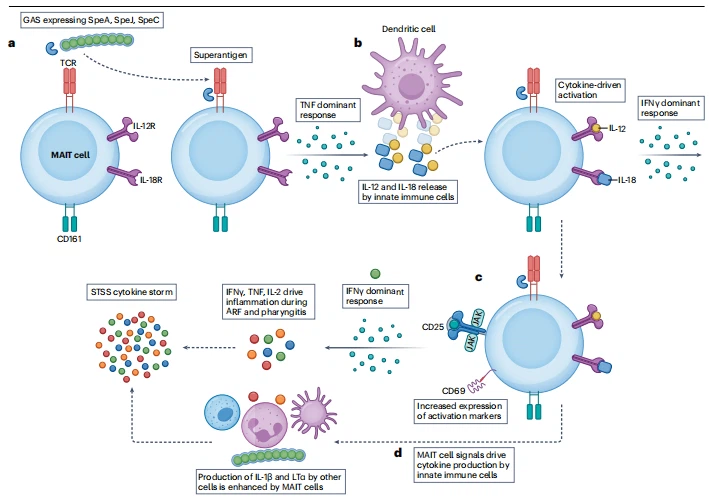
Daim duab 2|Txheej txheem cej luam ntawm pathogenic mechanisms ntawm MAIT cell activation thaum GAS kab mob
GAS epidemiology thiab evolution
Thawj tus kab mob kis kab mob ntawm GAS yog raws li cov tshuaj tiv thaiv kab mob M protein uas tau ua lub hauv paus hauv kev txhais cov kab mob GAS nyob rau ib puas xyoo dhau los. Ameslikas tsim raws li txoj kev serological125, M-typing scheme tau los ua gene-based nyob rau hauv 1990s tom qab molecular txoj kev txheeb xyuas tias cov hypervariable N-terminal cheeb tsam ntawm lub emm noob kis M protein sero-specificity126,127. Kev kis kab mob thoob ntiaj teb ntawm GAS raws li hom emm tau sau tseg hauv 2009 thaum qhov tseem ceeb ntawm GAS emm hom tau tshaj tawm nyob rau hauv cov nyiaj tau los siab, uas yog qhov sib piv rau cov nyiaj tau los tsawg (xws li hauv Africa thiab Pacific) qhov twg Cov hom GAS no tsis tshua pom thiab muaj qhov tsis muaj qhov tseem ceeb ntawm GAS emm hom hauv kev ncig 3. Tsis ntev los no, tag nrho cov genome-raws li txoj hauv kev tau siv los txheeb xyuas kev sib raug zoo ntawm GAS cov pej xeem raws li kev hloov pauv hauv tag nrho cov ntsiab lus ntawm cov noob caj noob ces thiab cov kab ke sib txawv sib txawv 17,128. Kev sib raug zoo ntawm cov cim kab mob sib kis xws li emm-hom thiab tag nrho-genome sequence pawg sib txawv nyob rau hauv lub ntiaj teb cov ntsiab lus, tsis tau gene-based txoj kev xws li mm-typing tau ua pov thawj zoo rau hauv zos, luv-lub sij hawm kev tshawb nrhiav. Cov ntawv txheeb xyuas tsis ntev los no muab cov keeb kwm yav dhau los rau kev sib tshuam ntawm genomics thiab GAS epidemiology129-131, thiab ntawm no peb tsom mus rau qhov kev nce qib tshiab hauv GAS cov pej xeem biology. Kev paub txuas ntxiv mus ntxiv hauv cov cheeb tsam no tau muab cov ntsiab lus tshiab hauv cov txheej txheem pathogenesis, cov txheej txheem zoo dua rau kev taug qab cov kab mob, kev sib kis tau zoo, thiab kev nce qib tshuaj tiv thaiv, uas nyob rau hauv lem yuav raug siv los txhim kho kev kho mob thiab pej xeem kev noj qab haus huv tswj ntawm GAS kab mob. Cov pej xeem genomic kev tshawb fawb tau pom tias tag nrho qhov loj ntawm GAS genome yog qhov ruaj khov ntawm 1.7–2.0 Mbp, encoding ntawm 1,500 thiab 2,000 noob. Kwv yees li ntawm 1,300 'core' genes raug khaws cia hauv txhua hom GAS, nrog rau cov khoom siv 'accessory' lossis cov ntsiab lus sib txawv ntawm cov noob kwv yees li 5 npaug ntau dua li cov tub ntxhais genome17,129. Lub hauv paus ntsiab lus ntawm GAS ntiaj teb cov pej xeem genomics revolves nyob ib ncig ntawm nws yog ib tug kab mob sib txawv nrog ntau pua co-evolving genome 'clusters' los yog 'lineages', nrog rau cov txheeb ze abundance thiab fluctuation ntawm cov pawg no txawv heev nyob rau hauv ob qho tib si geography thiab lub sij hawm. Txawm hais tias cov kab no yog cov kab mob sib txawv, lawv cov kev hloov pauv hloov pauv tau cuam tshuam los ntawm homologous thiab non-homologous recombination cov xwm txheej uas ua lub luag haujlwm tseem ceeb hauv kev hloov pauv kev vam meej ntawm ntiaj teb GAS kab. Qhov sib piv cov pej xeem qauv ntawm GAS ntawm ntau qhov chaw thaj chaw yog ua piv txwv nyob rau hauv daim duab 3, qhov twg alternating grey thawv sawv cev ~ 300 evolutionary txawv GAS kab raws li yav tas los tau teev tseg 17 thiab thaj tsam thaj tsam uas cov kab mob tau tshaj tawm yog xim-coded. Cov kab sib txuas ntawm ob lub ntsej muag (geography thiab genomic lineage) qhia tias txawm hais tias muaj ntau yam kab mob sib kis thoob ntiaj teb, thaj chaw Pacific thiab African thaj chaw muaj GAS kab uas tsis tshua pom nyob hauv lwm qhov chaw. Kev sib piv cov pej xeem ntawm GAS ntawm ntau qhov chaw thaj chaw tau ua piv txwv hauv qhov kev tshawb pom ua ntej los ntawm Gambia132, Kenya133, thiab tej thaj chaw deb Australia17,134 qhov chaw uas cov kab GAS circulating yog qhov txawv txav los ntawm cov neeg tau txais txiaj ntsig zoo. Ib qho kev txhais ntawm cov ntaub ntawv no yog qhov zaus ntawm GAS kab sib txawv thoob ntiaj teb, uas muaj kev saib xyuas ntau dua ntawm GAS genotypes los ntawm thaj chaw thaj chaw uas tus kab mob hnyav tshaj plaws. Txawm hais tias lub zog tsav tsheb rau kev saib xyuas ntawm qhov sib txawv ntawm lub cev-spatial qhov sib txawv ntawm cov pej xeem cov qauv tseem tsis meej, cov kev hloov pauv no yuav muaj kev sib cuam tshuam ntawm kev sib txawv ntawm txoj kev sib txawv, kev sib raug zoo-kev lag luam, thiab cov kab mob / tus tswv tsev xaiv cov txheej xwm. Genomic epidemiology tau ua qhov tseem ceeb hauv kev txheeb xyuas thiab taug qab cov kab mob GAS hauv kev soj ntsuam kev noj qab haus huv rau pej xeem, tshwj xeeb tshaj yog nyob rau hauv cov cheeb tsam tau nyiaj tau los uas cov genome sequencing rau cov kab mob uas tau xaiv tau yog qhov tseem ceeb thiab muaj peev xwm. Nws yog nyob rau hauv cov chaw no uas nyuam qhuav tshwm sim GAS emm1 clone tau txheeb xyuas (lub npe hu ua M1UK) uas txawv ntawm cov neeg progenitor M1 los ntawm muaj 27 ib leeg-nucleotide polymorphisms thoob plaws hauv cov tub ntxhais (~ 1.7 Mbp) genome4. Kev sib kis sai sai ntawm qhov kev txhawj xeeb ntawm qhov sib txawv no tau pom nyob thoob plaws lwm cov neeg tau txais txiaj ntsig soj ntsuam nodes135–137, qhia txog qhov xwm txheej kis thoob qhov txhia chaw. Cov xwm txheej molecular uas ua rau kev xaiv hloov GAS clones kuj suav nrog kev nrhiav tau ntawm cov noob caj noob ces nqa cov cim tiv thaiv kab mob thiab cov kab mob streptococcal superantigens, homologous recombination xwm txheej cuam tshuam nrog qhov tseem ceeb virulence loci (tshwj xeeb tshaj yog NADase-slocus), thiab kev hloov pauv hauv kev tswj hwm network, 120, 50. Txawm hais tias cov hauv paus ntsiab lus uas cuam tshuam rau kev hloov pauv ntawm GAS cov pej xeem tseem raug daws, qhov tseeb yog qhov kev hloov pauv yog ib qho kev hloov pauv thiab tsis tu ncua, cuam tshuam los ntawm lub cev thiab qhov chaw, uas sawv cev rau kev sib tw rau ntiaj teb kev soj ntsuam GAS thiab tsim qauv. ntawm kev kho mob. Txawm hais tias qhov teeb meem no, cov pej xeem genomic moj khaum tsis ntev los no tau siv los txhawb kev txhim kho GAS tshuaj tiv thaiv thoob ntiaj teb los ntawm kev txheeb xyuas cov tshuaj tiv thaiv GAS uas tau nthuav tawm thoob ntiaj teb kev pab cuam qib siab 17. Cov kev pom tsis ntev los no tau ua piv txwv li cas qhov kev daws teeb meem tau txais los ntawm tag nrho-genome sequencing tuaj yeem tso lub teeb tshiab ntawm txoj hauv kev sib kis uas yuav tsis yooj yim pom siv cov cuab yeej sib kis. Ib txoj kev tshawb fawb soj ntsuam cov kab mob kis kab mob kis thoob plaws ntau qhov kev soj ntsuam hauv Tebchaws Meskas pom muaj kev sib koom ua ke ntawm pawg kis kab mob feem ntau hauv cov pej xeem ntawm kev tsis zoo138. Ib qho tseem ceeb txuas ntxiv ntawm txoj kev tshawb no yog kev soj ntsuam tias pharyngitis thiab kab mob kis kab mob genomic pawg yuav sib koom tib lub network sib kis. Txawm hais tias qhov kev pab cuam ntawm ib puag ncig thiab fomite kis tau tus yam ntxwv tsis zoo, tsis ntev los no invasive GAS tshwm sim nyob rau hauv subacute kev kho mob chaw140,141 thiab scarlet fever tshwm sim nyob rau hauv tsev kawm ntawv-raws li kev soj ntsuam chaw142 qhia hais tias fomite-mediated, aerosol thiab tsev neeg-mediated kis tau tus mob pab mus rau kev sib kis. kab mob, ua rau GAS clones uas nyob rau hauv qee qhov chaw tuaj yeem nyob thiab dhau los ua tus tseem ceeb141. Cov kev tshawb pom no qhia tau hais tias GAS kab mob tshwm sim feem ntau tsis yog ib qho ntawm cov ntsiab lus, qhia txog qhov xav tau kev cuam tshuam cov tswv yim uas tsom txo GAS lub nra ntawm qhov chaw tseem ceeb ntawm kev kis kab mob (lub caj pas thiab daim tawv nqaij) ntxiv rau cov kev tiv thaiv thawj zaug tsom rau kev kawm txog kev noj qab haus huv. , txhim kho kev nyiam huv thiab txhim kho vaj tse nyob, tshwj xeeb tshaj yog nyob rau hauv qhov chaw ntawm kev tsis zoo143.
Nce hauv tshuaj tua kab mob
Kev kho tshuaj tua kab mob tseem yog qhov tseem ceeb ntawm kev saib xyuas rau kev kho mob ntawm ob qho tib si uas tsis muaj kab mob thiab kis kab mob GAS144. Txawm hais tias GAS tseem universally rhiab heev rau -lactam tshuaj tua kab mob, mechanisms conferring kuj rau thawj-hauv-line adjunctive thiab penicillin-lwm txoj kev kho mob (uas yog, macrolide thiab lincosamide tshuaj tua kab mob) feem ntau ua rau cov kab mob rov tshwm sim, kev kho tsis ua hauj lwm, thiab cov neeg mob tsis zoo 145-147. (Daim duab 4). Tsis tas li ntawd, qhov tshwm sim ntawm subclinical -lactam tsis kam hauv GAS tseem muaj kev txhawj xeeb tsis tu ncua 11-13.
Macrolide thiab lincosamide tsis kam
Ribosomal target site modification in GAS (that is, methylation of a single adenine in 23S ribosomal RNA (rRNA)), mediated by erythromycin resistance methylase (Erm) proteins, confers resistance to macrolides, lincosamides, and streptogramin B, subsequently giving rise to the MLSB phenotype. The MLSB phenotype is frequently attributed to the constitutive or inducible expression of ermB, ermTR (an ermA gene subclass), or ermT methylase encoding genes148. The ermB gene is widely carried on transposons Tn6002 and Tn6003, both derived from the insertion of ermB in Tn916-family mobile genetic elements149. The integrative and mobilizable element IMESp2907 is a primary carrier of ermTR150. Further, the plasmid-borne ermT gene — initially discovered in GAS in 2008 (ref. 151) — has become a significant source of macrolide and clindamycin resistance in GAS152. During invasive GAS disease, inducible erm expression has been associated with high rates of clindamycin-treatment failure13,153,154. The mefA (macrolide efflux pump A) gene in GAS, which is frequently associated with prophage phage φ1207.3 (formerly Tn1207.3), confers resistance to 14 and 15 carbon-ring macrolides (that is, erythromycin and azithromycin)155. Globally, rates of erythromycin and clindamycin resistance vary greatly. Between 2011 and 2019, the US Centers for Disease Control and Prevention (CDC) Active Bacterial Core surveillance program reported an increase from 11.9% to 24.7% and from 8.9% to 23.8% of invasive GAS isolates that were non-susceptible to erythromycin and clindamycin, respectively156, which was largely driven by the expansion of types emm77, emm58, emm11, emm83 and emm92 (ref. 157). Notably, in the United States, both erythromycin and clindamycin resistance have been identified as most frequent among persons experiencing homelessness, incarceration, drug use, and long-term admission to care facilities. In China, GAS surveillance spanning the past three decades suggests that the incidence of both clindamycin and erythromycin non-susceptible ermB expressing GAS has been high since the 1990s (>95% hauv cheeb tsam xaiv thaj chaw), txo cov kev siv tshuaj kho mob ntawm clindamycin154. Cov khoom sib xyaw ua ke thiab sib xyaw ua ke ICEemm12 tau raug txheeb xyuas tias yog tus tsav tsheb tseem ceeb ntawm macrolide tsis kam nyob rau hauv emm12 scarlet fever tshwm sim cais tawm ntawm cheeb tsam no6. Tsis ntev los no multicentre Northern European txoj kev tshawb fawb pom tau hais tias ob qho tib si erythromycin thiab clindamycin tsis kam yog li ntawm 1% mus rau 2% nyob rau hauv cov neeg mob uas nthuav tawm GAS necrotizing cov nqaij mos mos kab mob158. Ob qho tib si thoob ntiaj teb thiab lub teb chaws sib txawv hauv erythromycin thiab clindamycin tus nqi ntawm kev tiv thaiv feem ntau tuaj yeem raug ntaus nqi rau qhov sib txawv ntawm thaj chaw feem pua ntawm mefA-expressing txheeb ze rau erm-expressing cais uas muaj ntau dua ntawm clindamycin resistance154. Lub clonal thiab subclonal nthuav dav ntawm kev xaiv cov kab mob resistant, nrog rau kev hloov pauv ntawm lub sijhawm ntawm mefA-encoded thiab erm-encoded phenotypes thoob plaws thiab hauv emm hom ncig hauv thaj chaw tshwj xeeb, yog txhua yam uas tsav qhov zaus ntawm macrolide thiab lincosamide tsis kam hauv GAS6. 152, 159, 160.

Daim duab 3|Ntiaj teb no genetic ntau haiv neeg ntawm GAS.
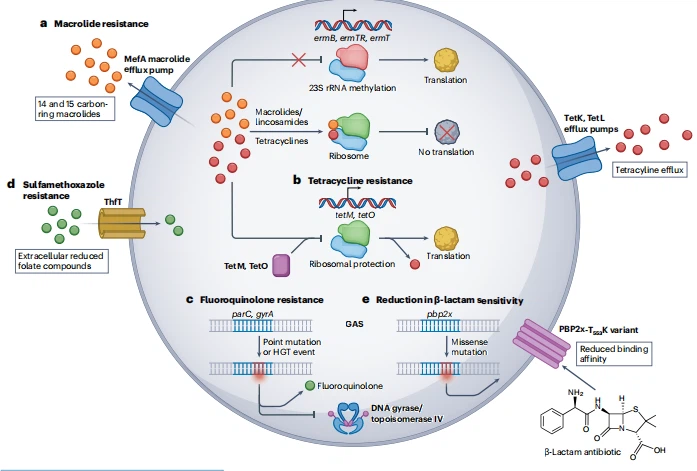
Daim duab 4|Mechanisms ntawm GAS tshuaj tiv thaiv kab mob. ib,
Tetracycline tsis kam
Hauv GAS, tetracycline tsis kam yog muab los ntawm ribosomal tiv thaiv noob tetM thiab tetO, thiab efflux twj system noob tetK lossis tetL161. Tau txais los ntawm kev hloov cov noob kab rov tav, tet noob feem ntau nthuav tawm ntawm ntau yam ntawm cov noob caj noob ces, feem ntau koom nrog erm thiab mef genes6. Hauv kev tshawb nrhiav rov qab los ntawm 2000 txog 2019 hauv Taiwan, 12.3%, 99.2%, thiab 13.1% ntawm macrolide-resistant GAS tau pom nyob rau hauv cov noob tetO, tetM thiab tetK, raws li 162. Nrog rau GAS clonal expansion, kev siv cov tshuaj tua kab mob tetracycline-chav kawm kuj tau hais kom tsav macrolide tsis kam thiab rov ua dua 1. Yog li ntawd, kev nrhiav tau ntawm tetracycline resistance determinants warrants tshwj xeeb thaum lub sij hawm tsis tu ncua thiab yav tom ntej epidemiological GAS soj ntsuam kev tshawb fawb.
Fluoroquinolone tsis kam
Txawm hais tias fluoroquinolones (FQs) tsis suav tias yog kev kho mob qhia rau kev tswj hwm tus kab mob GAS, qib qis thiab qib siab FQ tsis kam phenotypes hauv GAS tshwm sim nrog ntau zaus 163. Loj, cov ntaub ntawv hloov tshiab ntawm lub ntiaj teb tus nqi ntawm GAS FQ kuj tseem tsis tshua muaj. Ob qhov kev tshawb fawb ywj pheej tsis ntev los no tau txheeb xyuas tias FQ qhov tsis muaj kev cuam tshuam hauv Nyij Pooj tau muaj txij li 11.1% (nruab nrab ntawm 2011 thiab 2013) txog 14.3% (nruab nrab xyoo 2012 thiab 2018), feem ntau yog los ntawm kev sib kis ntawm emm6 thiab emm11 GAS5.64,16. Nyob nruab nrab ntawm xyoo 2011 thiab 2016, qhov zaus ntawm GAS FQ tsis muaj kev cuam tshuam hauv Shanghai, Tuam Tshoj, tau tshaj tawm ntawm 1.3%, nrog 80% ntawm FQ tsis cuam tshuam rau kev sib cais harboring ob qho tib si ermB thiab tetM kuj determinants. Hauv Shanghai, Tuam Tshoj, FQ tsis muaj kev cuam tshuam tau raug ntaus nqi los ntawm kev sib kis ntawm emm1, emm6, emm11 thiab emm12 GAS166. Interestingly, topoisomerase IV ParC-S79A kev hloov pauv kev sib tham nrog qib qis FQ tsis kam yog nquag txuam nrog emm6 GAS complex13. Tshwj xeeb tshaj plaws ntawm FQ noj tau raug sau tseg thoob ntiaj teb. Raws li tus neeg tsav tsheb ntawm FQ tsis kam hauv GAS, FQ kev siv tshuaj tua kab mob ua ke nrog qhov tshwm sim ntawm FQ multidrug-resistant clones underscores xav tau kev txhim kho thoob ntiaj teb hauv FQ stewardship kev coj ua.
Sulfamethoxazole tsis kam
Kev sib xyaw ua ke ntawm sulfamethoxazole thiab trimethoprim (tsim co-trimoxazole) tau ua haujlwm tsis ntev los no rau kev kho mob ntawm GAS daim tawv nqaij kab mob hauv cov chaw endemic168. Los ntawm kev tsom mus rau GAS folate voj voog, co-trimoxazole inhibits ob qho tib si de novo folate synthesis thiab lub voj voog folate. GAS tsis kam rau sulfamethoxazole thiab trimethoprim tau raug ntaus nqi los ntawm kev hloov pauv ntawm lub hom phiaj enzymes FolP thiab Dyr, raws li, los yog nrhiav tau ntawm trimethoprim-resistant variants ntawm Dyr (DfrF thiab DrfG) 169,170. Tsis tas li ntawd, kev ua haujlwm tsis ntev los no tau txheeb xyuas tias lub zog-coupling factor transporter S tivthaiv gene (thfT) ua rau GAS kom tau txais cov tshuaj txo qis folate ncaj qha los ntawm tus tswv tsev, hla qhov inhibition ntawm folate biosynthesis los ntawm sulfamethoxazole171. ThtF yuav tsum muaj tus tswv tsev metabolites rau kev ua si; Raws li xws li, tus qauv yam tsawg kawg nkaus inhibitory concentration (MIC) tsis txaus rau kev kuaj pom ntawm ThtF-mediated sulfamethoxazole kuj. Txawm hais tias tam sim no tsis tshua muaj ntawm thoob ntiaj teb GAS cais tawm, tam sim no nws yog ib qho tseem ceeb los saib xyuas qhov tshwm sim thiab kev nthuav tawm ntawm thfT-zoo GAS los coj cov kev kho mob tsim nyog.
-Lactam susceptibility
los ntawm kev hloov pauv hauv penicillin-binding proteins (PBPs), lub hom phiaj ntawm cov tshuaj tua kab mob -lactam. Txawm hais tias penicillin tsis kam siab tshaj qhov chaw kho mob hauv GAS tseem tsis tau sau tseg, lub zej zog GAS tshwm sim hauv Seattle (Washington, Tebchaws Asmeskas) tau coj mus rau kev txheeb xyuas ntawm ob qhov chaw kho mob emm43.4 GAS cais nrog yim-txo qis rau ob qho tib si ampicillin thiab amoxicillin. Raws li thawj kauj ruam hauv kev txhim kho -lactam tsis kam, kev hloov pauv tsis zoo (T553K hloov pauv) tau txheeb xyuas hauv PBP2x (ref. 14). Hauv peb qhov kev tshawb fawb ywj pheej tom ntej, cov kws sau ntawv tau tshuaj xyuas genome sequences ntawm 7,025, 9,667, thiab 13,727 GAS cais, raws li. Hauv thawj qhov kev tshawb fawb, 137 tawm ntawm 7,025 GAS hom tau txheeb xyuas kom muaj cov kev hloov pauv tsis yog qhov sib txawv hauv 36 codons ntawm pbp2x (ref. 11). Hauv txoj kev tshawb fawb thib ob, 84 ntawm 9,667 hom kab mob nqa PBP2x amino acid variations txuam nrog kev ua siab ntev rau subclinical penicillin MICs12. Hauv qhov kev tshawb fawb thib peb, uas tau tshuaj xyuas cov kab mob GAS cais tawm hauv Tebchaws Meskas los ntawm 2015 txog 2021, 388 PBP2x variants qhia tau hais tias nce -lactam MICs, nrog emm4 / PBP2x-M593T / ermT yog cov kab ke ua ntej; yav dhau los tau piav qhia emm43.3/PBP2x-T553K variant muaj nyob rau hauv ob qho kev cais thiab pom tau tias qhov siab tshaj plaws subclinical ampicillin MIC15. Raws li kev tshawb pom thawj zaug, tsuas yog qhov kev tshawb fawb tom qab tau pom tias muaj T553K hloov pauv hauv PBP2x hauv emm43.4 GAS, qhia txog qhov tshwm sim ntawm kev xaiv tshuaj tua kab mob tsis ntev los no. Nce subclinical tsis kam mus rau -lactam tshuaj tua kab mob hauv emm43.3/PBP2x-T553K variants tau raug ntaus nqi rau ntau yam uas tsis yog-PBP hloov pauv tam sim no hauv qhov tsis tshua muaj phenotype15. Txawm hais tias kev hloov pauv ntawm qhov tsis sib xws ntawm PBPs ib zaug tau xav tias yuav ua rau tus nqi qoj ib ce hauv GAS172, T553K hloov pauv hauv PBP2x qhia GAS tsis cuam tshuam rau kev loj hlob ntawm cov kab mob hauv vitro14. Tsis tas li ntawd, isogenic mutant GAS cais nrog PBP2x kev hloov pauv (P601L) uas txiav txim siab txo qis -lactam susceptibility qhia tias tsis muaj kev hloov pauv hauv vivo tab sis ua kom pom kev loj hlob hauv vitro173. Cov ntaub ntawv hais txog qhov no txhawb qhov kev ceev faj xav tau thaum saib xyuas -lactam resistance phenotypes hauv GAS.
Kev tsim tshuaj tiv thaiv GAS
Qhov nyuaj ntawm kev tsim tshuaj tiv thaiv GAS muaj kev nyab xeeb thiab zoo thoob ntiaj teb tau lees paub zoo18. Txawm hais tias ntau tshaj li ib puas xyoo ntawm kev tshawb fawb, GAS tshuaj tiv thaiv tsis tau mus txog kev siv lag luam. GAS cov tshuaj tiv thaiv tsim thiab kev tsim kho yuav tsum hla cov teeb meem ntawm ntau haiv neeg sib txawv, muaj peev xwm autoimmune epitopes, thiab cov teeb meem ntawm kev siv tsiaj cov qauv los ntsuas kev tiv thaiv kev tiv thaiv rau tib neeg nkaus xwb-hloov kab mob lub luag haujlwm rau ntau hom kab mob tshwm sim18. Cov teeb meem kev tshawb fawb no tau txuas ntxiv los ntawm keeb kwm kev tswj hwm thiab kev lag luam teeb meem rau GAS kev tsim tshuaj tiv thaiv. Undoubtedly qhov tseem ceeb tshaj plaws ntawm cov teeb meem no yog ib tug 25-xyoo US Federal Drug Administration (FDA) txwv rau kev tswj ntawm GAS thiab nws cov khoom rau tib neeg, tawm nyob rau hauv teb rau kev ntshai nyob ib ncig ntawm lub autoimmune peev xwm ntawm GAS antigens174. Txawm hais tias qhov kev txiav txim raug tshem tawm hauv 2005, tsuas yog plaub tus neeg sib tw tshuaj tiv thaiv txij li tau nce mus rau theem pib ntawm tib neeg kev sim (Table 2).

cistanche tubulosa- txhim kho lub cev tiv thaiv kab mob
Nyem qhov no mus saib Cistanche Enhance Immunity khoom
【Nug ntxiv】 Email: cindy.xue@wecistanche.com / Whats App: 0086 18599088692 / Wechat: 18599088692
M-protein txhaj tshuaj tiv thaiv
To date, all vaccine candidates in the clinical pipeline target the GAS M protein. M protein vaccines are specifically designed to exclude auto-epitopes and contain either a mixture of hypervariable N-terminal fragments from various clinically relevant M serotypes or conserved epitopes derived from the protein's C-repeat region. The most advanced multivalent N-terminal peptide-based candidate (StreptAnova) was well tolerated and immunogenic among participants in a 2019 phase I clinical trial175. StreptAnova was formulated based on the 30 M serotypes responsible for >90% of pharyngitis and invasive disease cases in North America and Europe176, but vaccine antisera from rabbits cross-opsonize numerous structurally similar non-vaccine serotypes that dominate diverse geographic regions176,177. Although cross-opsonization of non-vaccine serotypes is predicted to increase coverage of the 30-valent vaccine among populations in both Mali (from 37% to 84%)178 and South Africa (from 63% to >90%) 179, kev tshuaj xyuas tsis ntev los no qhia tau tias qhov kev pab them nqi tseem yuav tsis txaus rau cov neeg nyob rau sab qaum teb Australian qhov twg RHD yog endemic180. Lub hom phiaj ntawm kev txuag cov epitopes nyob rau hauv cheeb tsam C-repeat ntawm M protein yog li ntawd muaj txiaj ntsig zoo ntawm kev sib tham txog kev tiv thaiv thoob ntiaj teb tsis hais txog qhov xwm txheej tam sim no lossis yav tom ntej. Ib theem kuv kev soj ntsuam ntawm cov tshuaj tiv thaiv MJ8VAX, uas muaj C-repeat cheeb tsam B cell epitope J8, pom tau tias nce J8- tshwj xeeb cov tshuaj tiv thaiv kab mob hauv cov neeg ua haujlwm pab dawb tom qab txhaj tshuaj intramuscular181. MJ8VAX txij li thaum tau hloov kho raws li MJ8CombiVax, nrog rau qhov hloov kho ntxiv los ntawm SpyCEP uas muab kev tiv thaiv kev tiv thaiv kab mob covR/S mutants hauv tus qauv nas ntawm GAS daim tawv nqaij kab mob182. Cov tshuaj tiv thaiv StreptInCor thiab P*17, ob qho tib si kuj ua raws li thaj tsam C-repeat, txhawb kev tiv thaiv cov lus teb hauv nas GAS kev sib tw qauv 183,184. Kev nyab xeeb dav dav ntawm MJ8CombiVax thiab StreptInCor tau ua tiav hauv cov qauv nas thiab minipig, raws li kev npaj rau theem kuv sim. Tsis muaj pov thawj ntawm kev txhaj tshuaj tiv thaiv kab mob autoimmunity lossis toxicity nrog tus neeg sib tw tau pom.
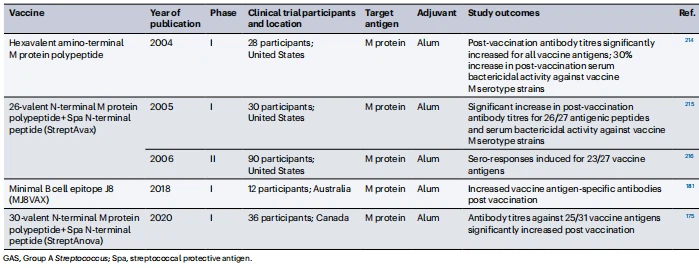
Table 2|Kev sim tshuaj tiv thaiv ntawm GAS cov neeg sib tw (tom qab xyoo 2004)
Cov tshuaj tiv thaiv tsis-M protein sib tw
Numerous studies have identified non-M protein antigens that are protective against GAS challenge in animal models. Multicomponent formulations of selected antigens with high gene carriage and low sequence variation within the global GAS population can theoretically offer high vaccine coverage17, and several experimental vaccines employing this strategy are efficacious in animal models. Leading candidates include the GlaxoSmithKline three-component vaccine (SLO, S. pyogenes adhesion and division protein (SpyAD) and SpyCEP)187, Vaxcyte's VAX-A1 (ScpA, SLO, and SpyAD conjugated to GAS cell wall carbohydrate containing only poly rhamnose (SpyAD-GACPR) 188, Combo#5 (arginine deiminase (ADI), trigger factor (TF), SpyCEP, ScpA, and SLO)189,190, 5CP (Sortase A (SrtA), ScpA, SpyAD, SpyCEP, and SLO)191 and Spy7 (ScpA, SpyAD, oligopeptide-binding protein (OppA), pullulanase A (PulA), Spy1228, Spy1037 and Spy0843)192, which when formulated with alum (or CpG oligodeoxynucleotides in the case of the 5CP vaccine) all stimulate protective immune responses in mouse models of GAS infection. Combo#5/alum vaccination also significantly reduces symptoms of pharyngitis and tonsillitis in non-human primates19. Another candidate, TeeVax, targets multiple T antigens of GAS pili using a multivalent approach analogous to the strategy employed for the StreptAnova vaccine. TeeVax/alum induces modest protection in an invasive GAS mouse model and antiserum from vaccinated rabbits reacts to all 21 T antigens included within the vaccine (representing >95% ntawm tag nrho cov paub tee serotypes) nrog rau peb yam tsis yog tshuaj tiv thaiv subtypes193.
Outlook rau kev tshawb fawb thiab kev tsim tshuaj tiv thaiv GAS
Xyoo tsis ntev los no tau pom muaj kev txhawb zog los ntawm cov neeg koom tes tseem ceeb los koom tes thiab qhia kev tshawb fawb tshuaj tiv thaiv GAS. GAS tshuaj tiv thaiv kev tshawb fawb thiab kev tsim kho tau tshaj tawm tias yog qhov tseem ceeb ntawm WHO 2018 kev daws teeb meem thoob ntiaj teb ntawm ARF thiab RHD194 thiab tau hais los ntawm WHO raws li kev cuam tshuam tseem ceeb tiv thaiv kev nce ntxiv hauv kev kis kab mob GAS thiab tshuaj tua kab mob ntau dhau 16. Lub koom haum WHO tam sim no tau tshaj tawm GAS Vaccine Development Technology Roadmap qhia txog cov yam ntxwv ntawm cov khoom nyiam thiab cov haujlwm tshawb fawb tseem ceeb los daws qhov tsis sib xws ntawm kev tshawb fawb, txhawb kev soj ntsuam kev soj ntsuam, thiab qhia txoj cai txiav txim siab 16. GAS tshuaj tiv thaiv kev tshawb fawb thiab kev txhim kho tau raug kev txom nyem los ntawm kev tsis muaj peev nyiaj txiag yav dhau los, tab sis kev tshawb fawb txog kev noj qab haus huv-kev lag luam tsis ntev los no kwv yees tias cov tshuaj tiv thaiv uas ua tau raws li WHO nyiam cov yam ntxwv ntawm cov khoom lag luam yuav tiv thaiv txog li $ 1 nphom hauv GAS cov nqi koom nrog txhua xyoo hauv lub xyoo. USA 195. Kev nce qib hauv kev tsim tshuaj tiv thaiv thiab kev xa khoom tau cia siab tias yuav txhim kho GAS cov tswv yim txhaj tshuaj. Txhua tus neeg sib tw tshuaj tiv thaiv GAS tau sim hauv kev sim tshuaj rau hnub tim tau tsim nrog alum thiab yog li nyiam TH2 cell-type (antibody) cov lus teb, txawm hais tias tsis ntev los no cov kev tshawb fawb hauv tsev kho mob nrog cov kev sim adjuvant CAF® 01 thiab emulsions uas muaj saponin QS21 taw tes rau qhov tseem ceeb ntawm inducing. ob leeg cellular (TH1 cell) thiab cov tshuaj tiv thaiv kab mob hauv GAS tiv thaiv 184,190. Microarray thaj chaw tshuaj tiv thaiv xa tawm muaj qhov zoo ntawm qhov muaj peev xwm noj tshuaj nrog kev txhim kho kev tiv thaiv kab mob, lub neej ntev dua, thiab siv tau yooj yim piv nrog kev txhaj tshuaj intramuscular. Tus neeg sib tw tshuaj tiv thaiv J8-DT tsis ntev los no tau raug tshuaj xyuas rau kev ua tau zoo siv cov khoom siv microarray thaj chaw siab, ua kom pom TH1 cell / TH2 cell induction thiab kev tiv thaiv zoo tshaj qhov txhaj tshuaj tiv thaiv kab mob tiv thaiv kab mob GAS ntawm daim tawv nqaij hauv nas196. Txawm hais tias tsis zoo tag nrho cov sawv cev ntawm tib neeg GAS tus kab mob, cov qauv tsiaj muaj txiaj ntsig rau kev kawm GAS cov neeg sib tw tshuaj tiv thaiv tau raug tsim thiab tsim qauv, suav nrog tus qauv nas humanized rau kev ntsuam xyuas tus kab mob GAS kab mob197, tus nas kab mob ntawm daim tawv nqaij model198, thiab tus qauv tsis yog tib neeg primate ntawm GAS pharyngitis19. . Tsis tas li ntawd, tib neeg GAS tus qauv kev sib tw tsis ntev los no tau tsim los ntawm cov kws tshawb fawb hauv tebchaws Australia yuav tsum qhia txog kev cuam tshuam ntawm kev tiv thaiv kab mob thiab ua kom nrawm rau kev soj ntsuam cov tshuaj tiv thaiv tam sim no thiab yav tom ntej20.
Cov lus xaus thiab cov kev xav yav tom ntej
GAS cov kab mob tshwm sim txuas ntxiv mus thoob plaws ntiaj teb, ua rau muaj kab mob tseem ceeb, thiab xav tau kev saib xyuas nrog kev siv zog txuas ntxiv mus rau kev tshawb fawb thiab kev noj qab haus huv rau pej xeem lub luag haujlwm tseem ceeb los txheeb xyuas cov kev hloov pauv ntawm cov kab mob GAS cov pej xeem. Txawm hais tias kev kis kab mob ntawm GAS tau hloov pauv ntau hauv qee lub tebchaws tsim kho nyob rau xyoo pua dhau los raws li kev hloov pauv ntawm kev lag luam hauv zej zog, kev sib koom tes los tsim kom muaj peev xwm thiab kev soj ntsuam ntawm cov chaw hauv cov chaw qis yog qhov tseem ceeb rau ob qho tib si txhais GAS kis tau tus mob chains thiab muab lub hauv paus rau ntsuas qhov cuam tshuam ntawm kev tiv thaiv yav tom ntej. Txawm hais tias lub cev tseem ceeb ntawm kev ua haujlwm piav qhia txog GAS virulence mechanisms tshwm sim, tus tswv tsev tshiab-cov kab mob sib cuam tshuam tau raug sau tseg, xws li kev sib cais ntawm GSDMA pro-inflammatory mechanism los ntawm GAS cysteine protease SpeB, ua rau pyroptosis. Txoj kev tshawb fawb ncaj qha ntawm tib neeg kis GAS tau muab cov kev xav tshiab, xws li lub luag haujlwm ntawm MAIT hlwb hauv cov neeg mob STSS. Kev ua haujlwm ntxiv uas siv tib neeg cov ntaub ntawv tus neeg mob tau lees paub meej thiab yuav muab kev pom zoo rau kev txhim kho yav tom ntej kho mob thiab prophylactics. Kev txheeb xyuas ntawm thawj kauj ruam PBP2x kev hloov pauv hauv GAS uas tau ua rau penicillin tsis raug rau lwm hom kab mob streptococcal yog qhov kev txhawj xeeb loj. Kev txhim kho cov tshuaj tiv thaiv GAS muaj kev nyab xeeb thiab siv tau los txo cov kab mob GAS tam sim no tau lees paub meej tias yog qhov tseem ceeb los ntawm WHO, cov neeg tsim tshuaj tiv thaiv, thiab lwm tus neeg muaj feem cuam tshuam. Kev lag luam, kev faib tawm, thiab kev siv tshuaj tiv thaiv ntau ntxiv yuav ua tau ntau yam los txo tus kab mob GAS, qhov suav ntawm qhov tseem ceeb ntawm kev kis kab mob tuag thoob ntiaj teb.
Cov ntaub ntawv
1. Walker, MJ et al. Kab mob tshwm sim thiab cov txheej txheem pathogenic ntawm Pawg A Streptococcus. Clin. Microbiol. Rev. 27, 264–301 (2014).
2. McMillan, DJ et al. Cov qauv tshiab ntawm Pawg A Streptococcus M cov proteins raws li kev tshawb fawb thoob ntiaj teb. Clin. Microbiol. Kab mob. 19, E222–E229 (2013).
3. Steer, AC, Law, I., Matatolu, L., Beall, BW & Carapetis, JR Ntiaj teb no emm hom kev faib tawm ntawm Pawg A streptococci: kev tshuaj xyuas thiab cuam tshuam rau kev tsim tshuaj tiv thaiv. Lancet Infect. Dis. 9, 611–616 (2009).
4. Lynskey, NN et al. Qhov tshwm sim ntawm cov tshuaj toxigenic M1T1 Streptococcus pyogenes clone thaum lub sijhawm ua npaws kub ua npaws hauv tebchaws Askiv: kev tshawb fawb txog cov pej xeem-raws li kev kis kabmob. Lancet Infect. Dis. 19, 1209–1218 (2019). Daim ntawv no qhia txog qhov tseem ceeb tshiab emm1 GAS kab (M1UK) uas yog tus cwj pwm los ntawm kev nce SpeA ntau lawm, uas tej zaum yuav ua rau muaj kev kub taub hau liab thiab kis kab mob hauv tebchaws Askiv.
5. Tse, H. et al. Molecular characterization ntawm 2011 Hong Kong scarlet fever tshwm sim. J. Kab mob. Dis. 206, 341–351 (2012).
6. Davies, MR et al. Kev tshwm sim ntawm scarlet fever Streptococcus pyogenes emm12 clones nyob rau hauv Hong Kong yog txuam nrog rau cov tshuaj lom thiab ntau yam tshuaj tiv thaiv. Nat. Genet. 47, 84–87 (2015).
7. Turner, CE et al. Scarlet fever upsurge in England thiab molecular-genetic analysis in North-West London, 2014. Emerg. Kab mob. Dis. 22, 1075–1078 (2016).
8. Deng, W. W. et al. Streptococcal pyrogenic exotoxin B cleaves GSDMA thiab ua rau pyroptosis. Xwm 602, 496–502 (2022). Daim ntawv tshaj tawm no qhia tau hais tias SpeB ua rau keratinocyte pyroptosis los ntawm cleaving GSDMA, muab cov txheej txheem rau inflammatory teb stimulation ntawm lub epithelial cell txheej.
9. LaRock, DL et al. Pawg A Streptococcus induces GSDMA-dependent pyroptosis hauv keratinocytes. Xwm Txheej 605, 527–531 (2022). Daim ntawv no qhia txog lub luag haujlwm ntawm SpeB hauv caspase 1-kev ua haujlwm ywj pheej ntawm GSDMA hauv cov hlwb ntawm daim tawv nqaij.
10. Emgård, J. et al. MAIT hlwb yog cov koom tes loj rau cov lus teb cytokine hauv Pawg A streptococcal toxic shock syndrome. Proc. Natl Acad. Sci. USA 116, 25923–25931 (2019).
11. Musser, JM et al. Txo hauv vitro susceptibility ntawm Streptococcus pyogenes rau -lactam tshuaj tua kab mob cuam tshuam nrog kev hloov pauv hauv cov noob pbp2x yog thaj chaw dav. J. Clin. Microbiol. 58, e01993-19 (2020).
12. Hayes, A., Lacey, JA, Morris, JM, Davies, MR & Tong, SYC Txwv kev sib txawv ntawm cov kab mob Streptococcus pyogenes penicillin-binding proteins. mSphere 5, e00090-20 (2020). 13. Chou, S. et al. Cov pej xeem thiab tag nrho cov genome ib ntus-raws li tus cwj pwm ntawm invasive Group A streptococci zoo zoo hauv Tebchaws Meskas xyoo 2015. mBio 8, e01422-17 (2017). Txoj hauj lwm no nthuav tawm cov ncauj lus kom ntxaws txog cov pej xeem loj-raws li genomic characterization ntawm invasive GAS cais tawm hauv Tebchaws Meskas.
14. Vannice, KS et al. Streptococcus pyogenes pbp2x mutation confers txo kev raug rau -lactam tshuaj tua kab mob. Clin. Kab mob. Dis. 71, 201–204 (2020).
15. Chou, S. et al. Invasive Group A streptococcal penicillin-binding protein 2x variants txuam nrog txo kev raug rau -lactam tshuaj tua kab mob hauv Tebchaws Meskas, 2015-2021. Antimicrob. Tus neeg saib xyuas Chemother. 66, e0080222 (2022).
16. Vekemans, GR & Kim Txoj kev mus rau Pawg A Streptococcus tshuaj tiv thaiv: WHO tshawb fawb thiab kev tsim kho thev naus laus zis txoj hauv kev thiab cov yam ntxwv ntawm cov khoom nyiam. Clin. Kab mob. Dis. 69, 877–883 (2019).
17. Davies, MR et al. Atlas ntawm Pab Pawg A cov tshuaj tiv thaiv kab mob streptococcal tau muab tso ua ke siv cov kev sib piv loj ntawm cov genomics. Nat. Genet. 51, 1035–1043 (2019). Txoj kev tshawb no siv thoob ntiaj teb GAS genomic cov ntaub ntawv teeb tsa los tsim lub platform rau
18. Kev tsim tshuaj tiv thaiv kab mob genomics. Dale, JB & Walker, MJ Hloov tshiab ntawm Pawg A streptococcal txhaj tshuaj tiv thaiv. Curr. Opin. Kab mob. Dis. 33, 244–250 (2020).
19. Rivera-Hernandez, T. et al. Ib qho kev sim pab pawg A Streptococcus tshuaj tiv thaiv uas txo cov pharyngitis thiab tonsillitis hauv cov qauv tsis yog tib neeg. mBio 10, e00693-19 (2019).
20. Osowicki, J. et al. Tus qauv tswj tib neeg tus kab mob ntawm Streptococcus pyogenes pharyngitis (CHIVAS-M75): kev soj ntsuam, kev tshawb nrhiav tshuaj. Lancet Microbe 2, e291–e299 (2021). Daim ntawv pov thawj no tau tshaj tawm thawj qhov kev tswj hwm GAS tib neeg tus qauv ntawm tus mob pharyngitis.
21. Tes, RM, Snelling, TL & Carapetis, JR Group A Streptococcus. hauv Hunter's Tropical Medicine and Emerging Infectious Diseases (eds Ryan, ET, Hill, DR, Solomon, T., Aronson, NE & Endy, TP) 429–438 (Elsevier, 2020).
22. Miller, KM et al. Lub nra thoob ntiaj teb ntawm mob caj pas thiab Pab Pawg A Streptococcus pharyngitis: kev tshuaj xyuas thiab kev tshuaj xyuas meta. EClinicalMedicine 48, 101458 (2022).
23. Cannon, JW et al. Kev lag luam thiab kev noj qab haus huv lub nra ntawm cov kab mob tshwm sim los ntawm Pawg A Streptococcus hauv New Zealand. Int. J. Kab mob. Dis. 103, 176–181 (2021).
24. Ordunez, P. et al. Rheumatic mob plawv lub nra, tiam sis, thiab kev tsis sib xws hauv Asmeskas, 1990-2017: kev tshawb fawb txog pej xeem. Lancet Glob. Health 7, e1388–e1397 (2019).
25. Lv, M. et al. Ntiaj teb lub nra ntawm tus kab mob rheumatic mob plawv thiab nws lub koom haum nrog kev txhim kho kev noj qab haus huv, 1990-2019. Eur. J. Prev. Cardiol. 29, 1425–1434 (2022).
26. de Loizaga, SR et al. Kab mob Rheumatic hauv Tebchaws Meskas: tsis nco qab tab sis tsis ploj mus: cov txiaj ntsig ntawm 10-xyoo ntau qhov kev tshuaj xyuas. J. Am. Lub plawv Assoc. 10, e020992 (2021).
27. Oliver, J. et al. Ua ntej Pawg A Streptococcus kab mob ntawm daim tawv nqaij thiab caj pas yog tus kheej cuam tshuam nrog mob rheumatic fever: pov thawj los ntawm New Zealand. BMJ Glob. Health 6, e007038 (2021).
28. Barth, DD et al. Cov txheej txheem kev kawm uas ploj lawm: kev soj ntsuam yav tom ntej los txiav txim txog kev kis mob ntawm Pab Pawg A streptococcal pharyngitis thiab impetigo nyob rau thaj tsam Western Australia. BMJ Qhib 12, e057296 (2022).
29. Park, DW et al. Cov xwm txheej thiab cov yam ntxwv ntawm kev ua npaws liab liab, Kaus Lim Qab Teb, 2008-2015. Tawm. Kab mob. Dis. 23, 658–661 (2017).
30. Yung, CF & Thoon, KC A 12-xyoo dhau los ua npaws liab liab hauv Singapore. Lancet Infect. Dis. 18, 942 (2018).
31. Lamagni, T. et al. Resurgence of scarlet fever in England, 2014–16: kev tshawb nrhiav cov pej xeem. Lancet Infect. Dis. 18, 180–187 (2018).
32. Cubria, MB, Delgado, J., Shah, BJ, Sanson, MA & Flores, AR Kev txheeb xyuas tus kab mob npaws liab liab Group A Streptococcus strains nyob rau hauv cov menyuam yaus ntawm Houston, TX, USA. Nkag mus. Microbiol. 3, 000274 (2021).
33. Walker, MJ et al. Kev kuaj pom tus kab mob npaws liab liab Group A Streptococcus hauv Australia. Clin. Kab mob. Dis. 69, 1232–1234 (2019).
34. W., V. et al. Muaj kev pheej hmoo rau tus kab mob Streptococcus invasive rau tsev neeg ntawm cov kab mob ua npaws liab liab, England, 2011-2016. Tawm. Kab mob. Dis. 25, 529–537 (2019).
35. Ron, M., et al. Invasive multidrug-resistant emm93.0 Streptococcus pyogenes strain harboring a novel genomic island, Israel, 2017–2019. Tawm. Kab mob. Dis. 28, 118–126 (2022).
36. Tyrrell, GJ, Tswb, C., Bill, L. & Fathima, S. Nce qhov tshwm sim ntawm invasive Group A Streptococcus kab mob hauv thawj haiv neeg, Alberta, Canada, 2003–2017. Tawm. Kab mob. Dis. 27, 443–451 (2021).
37. Valenciano, SJ et al. Invasive Group A kab mob streptococcal ntawm cov neeg txhaj tshuaj thiab cov neeg tsis muaj tsev nyob hauv Tebchaws Meskas, 2010-2017. Clin. Kab mob. Dis. 73, e3718–e3726 (2021).
38. Phillips, GN Jr, Flicker, PF, Cohen, C., Manjula, BN & Fischetti, VA Streptococcal M protein: -helical coiled-coil qauv thiab kev npaj ntawm lub cell nto. Proc. Natl Acad. Sci. USA 78, 4689–4693 (1981).
39. Li, Z. et al. Ib qho array ntawm M protein gene subtypes nyob rau hauv 1064 tsis ntev los no invasive Group A Streptococcus cais rov qab los ntawm cov kab mob tseem ceeb soj ntsuam. J. Kab mob. Dis. 188, 1587–1592 (2003).
40. Valderrama, JA et al. Pab pawg A streptococcal M protein activates NLRP3 inflammasome. Nat. Microbiol. 2, 1425–1434 (2017). Daim ntawv tshaj tawm no qhia tau hais tias M1 protein ua rau caspase 1-nyob ntawm NLRP3 inflammasome ua kom, ua rau pyroptotic macrophage cell tuag.
41. Richter, J. et al. Streptolysins yog thawj inflammasome activators hauv macrophages thaum tus kab mob Streptococcus pyogenes. Immunol. Cell Bio. 99, 1040–1052 (2021).
42. Okada, N., Liszewski, MK, Atkinson, JP & Caparon, M. Membrane cofactor protein (CD46) yog keratinocyte receptor rau M protein ntawm pawg A Streptococcus. Proc. Natl Acad. Sci. USA 92, 2489–2493 (1995).