Part 1: Bioactive Compounds Los ntawm Ephedra Fragilis: Extraction Optimization, Tshuaj Cwj Pwm, Antioxidant Thiab AntiGlycation Activities
Mar 26, 2022
Yog xav paub ntxiv. tiv taujtina.xiang@wecistanche.com
Abstract: Teb cov txheej txheem saum npoo av (RSM) nrog lub thawv-Behnken tsim (BBD) tau siv los ua kom zoo tshaj qhov extraction ntawm bioactive compounds los ntawm Ephedra fragilis. Cov txiaj ntsig tau qhia tias kev rho tawm nrog 61.93 feem pua ethanol ntawm 44.43 degree rau 15.84 h yog qhov kev daws teeb meem zoo tshaj plaws rau kev sib xyaw ua ke ntawm qhov sib txawv. Lub crude ethanol extract (CEE) tau txais nyob rau hauv qhov zoo tshaj plaws extraction tej yam kev mob yog sequentially fractionated nrog cov kuab tshuaj ntawm nce polarity. Cov ntsiab lus ntawm tag nrho cov phenolic (TP) thiab tag nrho flavonoid (TF) nrog rau covantioxidantthiab kev ua haujlwm antiglycation raug ntsuas. Lub phytochemical ntiv tes profile ntawm cov feem nrog cov kev ua haujlwm siab tshaj plaws yog tus cwj pwm los ntawm kev siv RP-HPLC. Cov ethyl acetate feem (EAF) muaj qhov siab tshaj plaws TP thiab TF cov ntsiab lus thiab nthuav tawm lub zog tshaj plaws antioxidant thiab antiglycation kev ua ub no. Pearson correlation tsom xam tau pom tias TP thiab TF cov ntsiab lus muaj kev sib raug zoo nrog cov tshuaj tiv thaiv antioxidant thiab antiglycation. Tag nrho, rau lub tebchaw tau txheeb xyuas hauv EAF ntawm E. fragilis, suav nrog plaub phenolic acids thiab ob flavonoids. Tsis tas li ntawd, kev tshuaj ntsuam xyuas molecular docking kuj tau pom tias muaj kev sib txuas ntawm cov khoom siv bioactive thiab lawv cov txheej txheem ntawm kev ua. Peb cov txiaj ntsig tau qhia cov pov thawj tshiab ntawm kev ua haujlwm antioxidant thiab antiglycation ntawm E. fragilis bioactive compounds uas tuaj yeem siv rau hauv kev kho mob thiab tiv thaiv kev laus thiab kev cuam tshuam ntawm glycation.
Ntsiab lus: Ephedra fragilis; teb cov txheej txheem; Box-Behnken tsim; bioactive compounds; RP-HPLC; antioxidant thiab antiglycation ua haujlwm

Nyem qhov no kom paub ntau yam khoom
1. Taw qhia
Qhov tsis tu ncua raug rau cov neeg ua phem los ntawm ntau qhov chaw tuaj yeem ua rau muaj kev nce ntxivdawb radicalsntau lawm hauv tib neeg lub cev, tshaj nws lub peev xwm los tswj lawv, thiab, dhau sij hawm, ua rau muaj kev loj hlob ntawm ntau yam kab mob oxidative kev nyuaj siab nrog rau kev laus thiab ntshav qab zib[1]. Vim li no,antioxidantssupplementation tuaj yeem pab tswj kom muaj kev noj qab haus huv zoo los ntawm kev tshem tawm ntau dhau ntawm cov dawb radicals [2]. Nws tau raug pom tias cov dawb radicals koom nrog cov txheej txheem glycation. Glycation, ib qho tshuaj tiv thaiv tsis muaj zog ntawm cov amino acids residues nyob rau hauv cov proteins thiab txo cov suab thaj, tshwm sim rau ntau dua raws li kev laus thiab hyperglycemia, uas ua rau cov khoom tiav glycation kawg (AGEs) ntau lawm thiab 3]. Ib cag ntawm nws cuam tshuam nrog cov proteins thiab hloov lawv txoj haujlwm, AGEs tuaj yeem ua tau
koom nrog cov receptor rau AGEs (RAGE), 45 KDa multi-ligand-cell nto receptor uas muaj nyob rau hauv immunoglobulin superfamily [4], thiab ua kom muaj ntau txoj hauv kev hauv nruab nrab ntawm lub cev nrog rau kev nce hauv cov dawb radicals ntau lawm uas ua rau muaj kev cuam tshuam ntawm pathologic. rau ntshav qab zib [5].
Nws yog qhov tsim nyog tias cov tshuaj tua kab mob antioxidants thiab radical scavenger molecules yog cov tiv thaiv zoo tiv thaiv cov txheej txheem no [6]. Kev siv cov nroj tsuag tshuaj hauv kev tiv thaiv thiab tiv thaiv kab mob cuam tshuam nrog oxidative kev nyuaj siab yog ib qho kev kho mob qub. Tsis ntev los no, ntau cov kev tshawb fawb tau pom tias cov metabolites theem nrab xws li tannins, phenolic acids, thiab flavonoids nrog dual antioxidant thiab antiglycation muaj peev xwm zoo dua hauv kev kho mob ntshav qab zib mellitus [7]. Yog li ntawd, kev txheeb xyuas qhov chaw tshiab ntawm phytochemicals uas muaj txiaj ntsig zoo tshem tawm cov dawb radicals thiab txo cov tsis-enzymatic glycation yog qhov txaus siab heev.
Ephedra fragilis yog ib tug tswv cuab ntawm Ephedra genus (Ephedracea tsev neeg) uas muaj ntau tshaj 60 hom loj hlob nyob rau hauv suab puam thiab semiarid tej yam kev mob nyob rau hauv ob lub hemispheres thoob plaws rau lub teb chaws [8]. Tau ntau tshaj 5000 xyoo, ntau hom hauv Ephedra genus tau nquag siv hauv tshuaj suav tshuaj (TCM) rau kev kho mob ntawm ntau yam kab mob; Muaj ntau qhov kev tshawb fawb qhia txog lawv cov txiaj ntsig kev noj qab haus huv ntau yam xws li tshuaj tiv thaiv kab mob [9, tshuaj tiv thaiv kab mob, tshuaj tiv thaiv angiogenic, [10], tshuaj tua kab mob, tshuaj tiv thaiv kab mob, pro-apoptotic [11], neuroprotective [12], hepatoprotective, thiab tshuaj tiv thaiv. oxidant zog [13] Flavonoids, alkaloids, phenolic acids, thiab lwm yam tebchaw hauv Ephedra cov nroj tsuag tau raug suav tias yog lub ntsiab phytochemical Cheebtsam rau cov tshuaj pharmacological no [14]. Hauv kev lag luam kws tshuaj, thim rov qab-theem high-performance kua chromatography (RP-HPLC) yog dav siv los ua ib txoj kev tshuaj ntsuam xyuas thiab txheeb xyuas cov tshuaj sib xyaw ua ke raws li lawv cov khoom sib txawv hydrophobic, txawm hais tias qee qhov kev tshawb fawb tau piav qhia hauv cov ntaub ntawv rau kev tshuaj xyuas tshuaj. Ephedra hom.
Cov txheej txheem rho tawm ntawm cov bioactive compounds los ntawm cov nroj tsuag sib txawv yog thawj kauj ruam tseem ceeb koom nrog hauv lawv cov kev soj ntsuam zoo thiab ntau [15]. Cov yam ntxwv sib txawv viz. Txoj kev rho tawm, hom hnyav thiab qhov concentration, qhov kub thiab txias, lub sijhawm, thiab lwm yam tuaj yeem cuam tshuam qhov muaj pes tsawg leeg thiab kev rho tawm ntawm cov tebchaw no [16]. Yog li ntawd, optimization ntawm cov txheej txheem extraction yog yuav tsum tau yield ib tug siab cov ntsiab lus ntawm cov nroj tsuag active compounds. Keeb kwm tsim nyob rau xyoo 1950 los ntawm Box thiab Wilson, cov txheej txheem teb saum npoo av (RSM) yog tam sim no cov cuab yeej siv feem ntau los ua, txhim kho, thiab ua kom zoo dua cov txheej txheem uas muaj kev ywj pheej muaj kev cuam tshuam rau cov lus teb xav tau. Ib qho kev xaiv ntau tshaj plaws hauv RSM los ntawm cov kws tshawb fawb yog Box-Behnken tsim (BBD) vim tias nws xav tau kev sim tsawg thiab, yog li ntawd, sawv cev rau lwm txoj hauv kev uas zam kev sim ntev thiab txo cov nuj nqis [17-19].
Txog rau hnub tim, tsis muaj kev tshawb fawb muaj nyob rau hauv cov ntaub ntawv hais txog cov extraction optimization ntawm E. fragilis bioactive compounds. Yog li ntawd, txoj kev tshawb no tsom txhawm rau txhim kho kev tshem tawm tag nrho phenolic (TP) thiab flavonoid (TF) cov ntsiab lus los ntawm E.fragilis los ntawm kev siv BBD. Cov ethanol extract (CEE) tau txais nyob rau hauv qhov zoo tshaj plaws extraction tej yam kev mob yog sequentially fractionated nrog cov kuab tshuaj ntawm nce polarity, thiab lawv cov antioxidant thiab antiglycation kev ua ub no tau soj ntsuam siv sib txawv hauv vitro xeem. Thaum kawg, peb tau ua hauv kev tshuaj xyuas silico kom nkag siab ntxiv txog cov txheej txheem los ntawm bioactive compounds hauv EAE, raws li tau txheeb xyuas los ntawm cov txheej txheem rov qab-theem high-performance kua chromatography (RP-HPLC), khi rau BSA thiab RAGE raws li lub hom phiaj proteins.

2. Cov txiaj ntsig thiab kev sib tham
2.1. Haum rau Cov Qauv
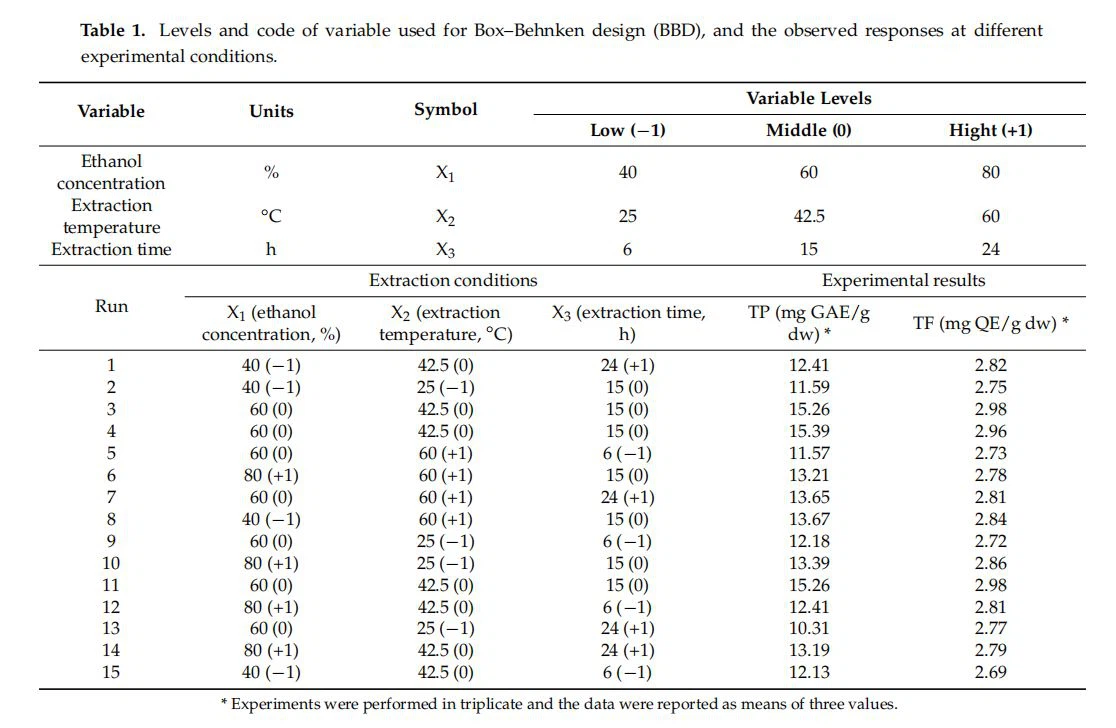
RSM with a BBD was applied to investigate the effect of ethanol concentration (%, Xj), temperature(°C, X2), and time (h, X3)on the extraction yield of TP and TF from E. fragilis. The results of 15 trials after the BBD are given in Table 1. Analysis of variance(ANOVA)(Table 2) indicates that the models were significant as evidenced by F and p-values. The coefficient of multiple determinations (R')of the models were 0.9935 and 0.9939 for TP and TF, respectively, suggesting that only 0.65 and 0.61%of the total variations are not explained by the models. A comparable value of adjusted R2 to R2 represents an excellent statistical model. As given in Table 2, the adjusted R2(0.9818 and 0.983 for TP and TF contents, respectively) is close to R2, which means that the insignificant terms were not included in the models. Moreover, predicted R2(0.9012 and 0.9338 for TP and TF contents, respectively) is in reasonable agreement with adjusted R2 and confirms that the models are highly significant. The"fitness" of the models was also confirmed using the lack of fit test The insignificant p-value for lack of fit (p >{{0}}.05) rau ob lo lus teb qhia qhov tsim nyog ntawm cov qauv rau kev kwv yees qhov tseeb ntawm qhov hloov pauv hauv cov txiaj ntsig [20]. Ib qho zoo precision yog piav raws li lub teeb liab-rau-lub suab sib piv ntau dua 4, uas yog suav hais tias xav tau [21]. Qhov tseem ceeb ntawm qhov txaus precision yog 29.4772 thiab 28.729 rau TP thiab TF cov ntsiab lus, raws li, ua kom pom lub teeb liab txaus. Ib txhij, qhov me me ntawm qhov sib txawv ntawm qhov sib txawv (CV feem pua ) (1.52 thiab 0.4246 feem pua rau TP thiab TF cov ntsiab lus, feem) qhia tau zoo dua qhov tseeb thiab kev ntseeg siab ntawm cov txiaj ntsig kev sim. Rau txhua qhov lus teb, kev cuam tshuam ntawm cov khoom rho tawm XI (ethanol concentration), X2 (qhov kub ntawm qhov rho tawm), thiab X3 (lub sijhawm rho tawm) tau ua tib zoo tshuaj xyuas (Table 2). Qhov tseem ceeb ntawm txhua tus coefficient tau sim siv F thiab p-tus nqi, txiav txim siab tias F-tus nqi ntau dua thiab tus nqi me me ib txwm ua rau muaj kev sib txuas lus tseem ceeb ntawm ntau yam kev ywj pheej [22]. Ua ke, cov txiaj ntsig no tau qhia tias cov qauv tsim tawm thiab tsim nyog rau kev ua kom zoo dua.

2.2. Cov teebmeem ntawm Extraction Variables ntawm TP Cov Ntsiab Lus
Raws li tau muab rau hauv Table 2, ANOVA cov txiaj ntsig tau pom qhov tseem ceeb linear (X, thiab X2), quadratic (Xj, X5, thiab X), thiab sib tham sib (X1X, thiab X2X3) cuam tshuam rau TP cov ntsiab lus. Ntawm cov no, TP cov ntsiab lus feem ntau yog nyob ntawm X, X3 ntawm p<0.001 followed="" by="" x1="" and="" x1x,="" at=""><0.01. the="" following="" second-order="" polynomial="" equation="" could="" be="" used="" to="" express="" the="" relationship="" between="" tp="" content="" and="">

Tus nqi ntawm qhov tsis haum yog qhov tsis tseem ceeb (F-tus nqi =11.02, p-value=0.0843), indi-cating tias tus qauv zoo-itted nrog zoo twv (R{ {9}}.9935; Adj R2=0.9818)(Table 2).
Kev sib cuam tshuam ntawm ethanol concentration thiab extraction kub (XjX2) tsim ib qho tseem ceeb heev (p<0.01)effect on="" tp="" content="" (table2).="" as="" ethanol="" concentration="" (x1)="" and="" extraction="" temperature="" (x)increase="" in="" the="" range="" of="" 40-61.80%="" and="" 25-44.30°c="" respectively,="" the="" tp="" content="" increases="" rapidly.="" however,="" beyond="" 61.80%and="" 44.30°c,="" tp="" content="" decreases="" slightly(figure="" 1a).="" however,="" the="" interaction="" of="" the="" extraction="" temperature="" and="" extraction="" time="" (x2x3)showed="" a="" highly=""><0.001) effect="" on="" tp="" content="" (table="" 2).="" as="" shown="" in="" figure="" 1b,="" tp="" content="" slightly="" improved="" with="" increasing="" extraction="" temperature="" (x2)and="" extraction="" time="" (x3)up="" to="" 44.37℃c="" and="" 15.77="" h,="" respectively,="" but="" diminished="" slowly="">

Cov teebmeem no tuaj yeem yog vim qhov tseeb tias phenolic tebchaw yog cov polar molecules uas ib txwm tshwm sim nrog glucosides, uas ua rau lawv ntau dej-soluble [23]. Raws li kev rho tawm ntawm phenolic tebchaw yog nyob ntawm qhov hnyav polarity, cov dej cawv sib xyaw ua haujlwm zoo dua hauv nws cov extraction dua li cawv ib leeg [20]. Hais txog lub hauv paus ntsiab lus "zoo li-dissolves-zoo li", qhov txo qis hauv ethanol concentration ua rau muaj kev nce hauv polarity ntawm cov kuab tshuaj, uas yuav pab kom yaj TP [15]. Txawm li cas los xij, qhov siab ethanol concentration tuaj yeem cuam tshuam tus nqi rho tawm los ntawm kev tiv thaiv kev tawg ntawm phenolic tebchaw. Ib yam li ntawd, qhov nce hauv qhov kub thiab txias tau txhim kho qhov kev rov qab los ntawm lub hom phiaj phenolic tebchaw los ntawm softening ntawm cov ntaub so ntswg, ua kom tsis muaj zog ntawm cov phab ntsa ntawm tes, txhim kho huab hwm coj hloov thiab nkag mus rau cov kuab tshuaj rau hauv cov nroj tsuag matrix, thiab nce ob qho tib si solubility thiab diffusion tus nqi; Txawm li cas los xij, qhov kub thiab txias dhau rau lub sijhawm ncua sij hawm rho tawm tuaj yeem ua rau muaj feem ntawm lawv cov degradation [23]. Tsis tas li ntawd, lub sij hawm rho tawm ntev tau pom tias muaj peev xwm txuas tau cov pa oxygen thiab lub teeb pom kev zoo, uas thaum kawg txhim kho txoj kev pheej hmoo ntawm cov dawb radicals tsim uas tuaj yeem khawb los ntawm phenolic tebchaw [23]. Yog li ntawd, ncua sij hawm rho tawm tsis tau pab kom ua tiav cov txiaj ntsig rho tawm [24].
2.3.Qhov cuam tshuam ntawm Extraction Variables ntawm TF Cov Ntsiab Lus
Raws li pom tseeb los ntawm Table2, cov teebmeem linear ntawm X thiab X3; quadratic teebmeem ntawm X, thiab X; thiab kev cuam tshuam cuam tshuam ntawm X1X2 thiab XjXg tau pom cov teebmeem tseem ceeb ntawm TF cov ntsiab lus. Ntawm txhua yam tseem ceeb, TF feem ntau yog nyob ntawm X3, X, X, X, thiab X1X2 ntawm p.<0.001 followed="" by="" x="" andx1x3="" at=""><0.01. the="" fitted="" second-order="" polynomial="" of="" tf="" content="" is="" as="">

Tus nqi tsis tseem ceeb ntawm qhov tsis haum (F-tus nqi=1.13; p-value=0.5024) qhia tias tus qauv npaj haum haum rau qhov kev cuam tshuam ntawm qhov sib txawv rau cov lus teb nrog qhov zoo kev twv ua ntej (R2=0.9939; Adj R2= 0.9830) (Table 2).
Ntau yam 3D teb cov duab kos tau tsim rau TF cov ntsiab lus thiab pom hauv daim duab 1D-F. Kev sib cuam tshuam ntawm ethanol concentration thiab extraction kub (X1X2) qhia qhov tseem ceeb (p<0.001) effect="" on="" tf="" content.="" from="" figure="" 1d,="" tf="" content="" increased="" at="" first="" and="" then="" decreased="" quickly="" with="" the="" rise="" of="" the="" two="" parameters,="" and="" a="" maximum="" tf="" content="" was="" achieved="" when="" ethanol="" concentration="" (xj)="" and="" extraction="" temperature="" (xo)were="" 61.89%="" and="" 44.23°c,="" respectively.="" this="" phenomenon="" is="" similar="" to="" tp,="" which="" might="" also="" be="" attributed="" to="" the="" fact="" that="" a="" rise="" in="" the="" extraction="" temperature,="" the="" solubility,="" extraction="" rate,="" and="" diffusion="" rate="" increase,="" which="" ultimately="" helps="" tf="" to="" dissolve="" insolvent="">
Ib yam li ntawd, kev sib cuam tshuam ntawm ethanol concentration thiab lub sij hawm rho tawm (XIX3) tau pom qhov sib txheeb zoo sib xws (Daim duab 1F). Kev rho tawm tawm ntawm TF maj mam nce nrog nce ob qho tib si ethanol concentration (Xj) thiab lub sij hawm rho tawm (X3). Nyob ze ntawm qhov nruab nrab ntawm cov lus teb (61.89 feem pua thiab 15.81 h rau X thiab X3, feem), TF yield tau mus txog qhov siab tshaj plaws tab sis txo qis tom qab ntawd. Qhov tshwm sim no feem ntau yog vim Fick txoj cai thib ob ntawm diffusion hauv paus ntsiab lus qhia tias qhov sib npaug kawg ntawm qhov kev daws teeb meem hauv cov khoom matrix thiab hnyav yuav tau txais tom qab lub sijhawm tshwj xeeb, ua rau kev txo qis hauv kev rho tawm cov txiaj ntsig ntawm lub hom phiaj sib txuas [26] .
2.4. Validation ntawm Optimized Conditions
Lub hom phiaj ntawm kev ua kom zoo dua yog los txiav txim siab txog cov txheej txheem rho tawm uas yuav muab ib txhij ntawm cov ntsiab lus siab tshaj TP thiab TF. Tsim cov kws tshaj lij software tau siv los ua kom zoo dua. Lub BBD tau thov kom pom qhov zoo tshaj plaws ethanol concentration, extraction kub, thiab lub sij hawm yuav tsum 61.93 feem pua, 44.43 degree, thiab 15.84h, raws li, raws li, rau extraction ntawm E. fragilis bioactive compounds. Ntawm qhov kev pom zoo no, qhov kwv yees TP thiab TF cov ntsiab lus yog 15.335 mg GAE / g dw thiab 2.972 mg OE / g dw, ntsig txog (Table3). Kev lees paub ntawm qhov kev kwv yees muaj peev xwm ntawm cov qauv tau sim ua raws li cov xwm txheej zoo tau txais los ntawm RSM. Kev sim tau ua nyob rau hauv triplicate raws li qhov tau txais, thiab cov ntsiab lus TP thiab TF yog 14.98±{13}}.29GAE/g DW thiab 2.92±{17}}.09 QE/g dw, feem. Qhov kev sim qhov tseem ceeb ntawm kev soj ntsuam cov lus teb tau sib piv thiab nyob rau hauv txoj kab nrog cov kev kwv yees qhov tseem ceeb, uas tau lees tias cov qauv txaus los cuam tshuam qhov kev xav tau ntawm kev ua kom zoo.

2.5. Extraction Yield thiab Phytochemical Analysis
Table 4 qhia txog kev rho tawm tawm ntawm E.fragilis CEE thiab nws cov feem. Peb cov txiaj ntsig tau pom tias cov txiaj ntsig ntawm kev rho tawm hauv cov feem sib txawv txawv ntawm 0.78 mus rau 10.6 feem pua (w/wo).Raws li pom hauv Table 4, CEE(1{{14}) }.6 feem pua ) muaj qhov feem pua siab tshaj plaws, ua raws li WF (2.73 feem pua), WBF (2.04 feem pua), DMF (0.64 feem pua), thiab EAF (0.93 feem pua), whereas HF (0.78 feem pua) ) muaj qhov feem pua tsawg tshaj tawm.

TP cov ntsiab lus ntawm E. fragilis CEE thiab nws cov seem tau txiav txim siab los ntawm kev sib npaug ntawm kev sib npaug ntawm kev ntsuas nkhaus (y {{0}}}.009x-0.{{ 25}}154; R2=0.9973) thiab qhia hauv milligrams gallic acid sib npaug (GAE) ib gram ntawm qhov hnyav qhuav (Table 4). Feem ntau, EAF muaj cov ntsiab lus TP siab tshaj plaws (32.78±{29}}.49 mg GAE/g DW) ua raws li WBF, DMF, thiab CEE (25.02 ± 1.01,19.21± 0.22 thiab 14.98± 0.29 mg GAE/g. DW), whereas, WF thiab HF nthuav tawm cov ntsiab lus qis tshaj plaws (10.47 ± 0.71 thiab 8.14 ± 0.17 mg GAE / g DW, feem). TF cov ntsiab lus ntawm E. fragilis CEE thiab nws cov feem raug soj ntsuam los ntawm txhuas chloride colorimetric assay sivquercetinas a standard (y=0.0295x+0.0361; R2=0.9986)(Table 4). Similar to the TP content, the same results were observed in the TF content with the highest and lowest content being detected in the EAF(10.50 ± 0.11 mg OE/g of DW)and HF(1.65± 0.13 mg OE/g of DW), respectively. The TF content is arranged as the following sequence: EAF>WBF>DMF> CEE>WF>HF. Interestingly, TP thiab TF cov ntsiab lus hauv EAF yog 2.18 thiab 3.59-fold siab dua li ntawm CEE, qhia tias ethyl acetate yuav yog cov kuab tshuaj tsim nyog los mloog ntau cov phenolics thiab flavonoids compounds thaum lub sij hawm CEE fractionation. Peb cov ntaub ntawv hais txog TP thiab TF cov ntsiab lus zoo ib yam nrog cov Yao li al. [27] uas tau tshaj tawm tias EAF tau txais los ntawm cov nroj tsuag tshuaj Pyrola asarifolia muaj qib siab tshaj plaws ntawm phenolics thiab flavonoids piv rau lwm feem (petroleum ether, n-butanol, thiab dej). Hauv lawv txoj kev tshawb fawb, Bhardwaj li al. [28] kuj tau tshaj tawm cov txiaj ntsig zoo sib xws thaum siv ob peb cov kuab tshuaj nrog nce polarity (n-hexane, chloroform, ethyl acetate, thiab n-butanol) hauv kev sib cais ntawm cov nroj tsuag tshuaj Codonopsis clematidea. Raws li cov kws sau ntawv no, EAF muaj qhov siab tshaj plaws TP thiab TF cov ntsiab lus nyob deb ntawm cov n-butanol, chloroform, thiab hexane. Qhov kev hloov pauv tseem ceeb hauv kev rho tawm cov txiaj ntsig, muaj pes tsawg leeg, thiab purity ntawm phenolic tebchaw ntawm cov feem yog tej zaum vim qhov sib txawv ntawm cov polarity ntawm cov khoom muaj nyob rau hauv cov ntaub ntawv cog, lawv cov qauv tshuaj, lawv cov polymerization degree, thiab lawv kev sib cuam tshuam nrog ib leeg [29 ].

2.6. Hauv Vitro Antioxidant Kev Ua Haujlwm
2.6.1.DPPH"Kev Ua Si Kev Ua Si
DPPH" yog ib qho ntawm ob peb cov dawb radicals ruaj khov uas tau siv dav los tshawb xyuas cov peev txheej antioxidant ntawm cov nroj tsuag rho tawm [30]. Ib qho extract lub peev xwm scavenger feem ntau cuam tshuam nrog nws lub peev xwm los tshem tawm cov dawb radicals ruaj khov, uas yog vim nws lub peev xwm hydrogen pub dawb. .
Lub peev xwm scavenging ntawm CEE / feem ntau nrog rau VC ntawm cov koob tshuaj sib txawv ntawm DPPH * dawb radical tau kawm. Daim duab 2A qhia tau hais tias tag nrho cov seem tau nthuav tawm pom tseeb DPPH·scavenging kev ua si nyob rau hauv ib koob tshuaj nyob rau hauv ntau ntawm 0.1 mus rau 1 mg/mL.At ib koob tshuaj ntawm 1mg/mL, 64.32,44.1{{22} },67.24,86.63,80.95,51.37,and99.62 feem pua ntawm DPPH"radical tau quenched los ntawm CEE, HE, DMF, EAF, WBF, WF thiab VC, raws li. Qhov qis tshaj IC50 rau scaveng-ing DPPH"ntawm tag nrho cov seem tau pom los ntawm EAF(0.116±{{30}}}015 mg/mL ) ua tiav los ntawm WBF (0.175 ± 0). ± 0.044 mg/mL).WFand HFs qhia qhov sib piv siab dua IC50 qhov tseem ceeb (0.964 ± 0.178 thiab 1.245 ± 0.105 mg / mL), feem.

Observed differentials in the scavenging activities of the fractions against the DPPH*radical may be assigned to the structural characteristics and the number of phenolic compounds present in each fraction. Similar results were observed in the medicinal plant Liquidambar formosana Hance leaf since the EAF was more effective than the other fractions (dichloromethane, n-butanol, and water fractions)[31]. As a standard molecule, ascorbic acid (VC) displayed the lowest IC50 value (0.039 ±0.009 mg/mL) in comparison to all fractions. The scavenging potential is in decreasing order of VC>EAF> WBF>DMF >CEE>WF>HF.
Tus nqi IC50 rau DPPH radical scavenging tau zoo sib xws nrog ob qho tib si TP cov ntsiab lus (r=0.963;p<0.01) and="" tf="" content(r=""><0.01)as presented="" in="" table="" 5.="" therefore,="" the="" discovered="" antioxidant="" activity="" suggested="" that="" eaf="" can="" be="" a="" source="" of="" numerous="" natural="" compounds="" with="" antioxidant="" properties="" that="" can="" act="" as="" hydrogen="" donors="" to="" terminate="" the="" process="" of="" oxidation="" by="" converting="" the="" free="" radicals="" to="" their="" stable="">

2.6.2.ABTS · ntxiv rau Kev Cuam Tshuam
Qhov kev ntsuam xyuas ABTS scavenging feem ntau yog siv los ua qhov ntsuas los qhia thiab tshawb xyuas lub peev xwm antioxidant ntawm cov tebchaw ntshiab nrog rau cov khoom siv ntuj tsim [32,33]. Lub fading ntawm xiav / ntsuab xim ntawm ABTS * chromophore ntawm 734 nyob rau hauv lub xub ntiag ntawm cov nroj tsuag extract yuav qhia tau hais tias ib tug antioxidant kev ua si.
Raws li pom nyob rau hauv daim duab 2B, qhov scavenging nkhaus ntawm CEE/fractions ntawm ABTS * ntxiv rau exhib-ited ib tug upward trend li cov concentration nce. Ntawm 1 mg/mL, qhov kev tshem tawm ntawm CEE, HF, DMF, WBF, EAF, WF, thiab VC yog 80.31,40.54,88.76, 9{{2{ {22}}}}.11,82.97, 67.36, thiab 94.9{24}} feem pua , feem. Ntawm tag nrho cov feem, qhov tsawg kawg nkaus ICs 0 tus nqi tau pom los ntawm EAF(0.11{{30}}±{34}}.014 mg/ mL) ua los ntawm DMF({38}}.196±{41}}.023 mg/mL), WBF (0.277±0.031 mg/mL), CEE(0.429 ± 0.039 mg / mL), thiab WF (0.654 ± 0.043 mg / mL), thaum HF tso tawm qhov siab tshaj ICs0 tus nqi (1.314 ± 0.104 mg / mL). Sib sau ua ke, qhov kev tshawb pom no tau pom zoo nrog ntawm Kaewseejan thiab Siriamornpun [29]. Kev sib piv nrog lub peev xwm inhibitory ntawm VC (0.025 ± 0.005 mg / mL) tau pom tias cov kev ua haujlwm ntawm CEE thiab nws cov feem tsis muaj zog me ntsis.
Raws li tau nthuav tawm hauv Table 5, qhov sib txuam tseem ceeb ntawm ABTS radical scavenging nrog TP cov ntsiab lus (r=0.921;p<0.01), and="" a="" significant="" correlation="" with="" tf="" content="" (r=""><0.05), were="" shown.="" this="" finding="" confirms="" the="" results="" obtained="" for="" the="" dpph*scavenging="" assay,="" proving="" the="" capacity="" of="" eaf="" to="" scavenge="" free="">
2.6.3. H2O2 Tshem Tawm Kev Ua Haujlwm
Ua ib tug tseem ceeb contributor rau oxidative kev nyuaj siab, H2O2 diffuses nkag tau los ntawm cov hlwb nyob rau hauv daim nyias nyias raws li ib tug messenger molecule [34]. Noj ua ke, H2O2 nws tus kheej tsis txaus ntshai [35], tab sis nws tuaj yeem hnov mob nrog Fe2 los ntawm Fenton cov tshuaj tiv thaiv thiab ua rau muaj zog heev reactive hydroxyl radical (OH *) [36]. Yog li, nws yog qhov kev puas tsuaj tshaj plaws ntawm ROS rau biomolecules. Nws yog, yog li ntawd, yuav tsum tau soj ntsuam lub peev xwm ntawm CCE thiab nws cov feem ntau ntawm kev tshem H2O2.
Scavenging activities of CEE/fractions, as well as standard antioxidants, were presented in Figure 2C. Notably, all extracts showed a strong scavenging activity on HO, which increased with the increase of sample doses ranging from 0.1 to 1 mg/mL. Moreover, the H2O2 scavenging potential decreased in the order of EAF> WBF>DMF>CEE>WF>HF, thiab cov peev txheej scavenging sib xws ntawm 1.0 mg/mL yog 84.56,75.24, 67.17,56.18, 50.19, thiab 34.95 feem pua, feem, uas qis dua li ntawm VC (98.03%).
Ntawm tag nrho cov feem, EAF pom qhov qis tshaj IC50 tus nqi (ICs0= 0.098±0.013 mg/mL), thiab nws tau ntau dua li ntawm VC (0.024 ± 0.006 mg/mL). Qhov no tej zaum yuav yog vim muaj cov phenolic siab thiab flavonoid tebchaw nyob rau hauv EAF, uas yog dav paub los ua lub luag haujlwm tseem ceeb ua antioxidants hauv cov kab mob lom. Hauv peb txoj kev tshawb fawb tsis ntev los no, peb tau pom lub peev xwm ntawm EAF los ntawm E.fragilis los tiv thaiv Tetrahymena pyriformis tiv thaiv H2O2-induced oxidative puas tsuaj [37].
Peb cov ntaub ntawv tsom xam tau piav qhia tias, raws li DPPH" thiab ABTS * ntxiv rau cov txiaj ntsig, qhov muaj txiaj ntsig zoo ntawm ICs 0 tus nqi rau H2O2 scavenging tau sau tseg nrog ob qho tib si TP cov ntsiab lus (r=0.926; p<0.01) and="" tf="" content="" (r=""><0.01)(table 5).="" in="" their="" study,="" sroka="" and="" cisowski="" [38]="" reported="" also="" a="" positive="" correlation="" between="" phenolic="" compounds="" with="" ho2-scavenging="" ability.="" according="" to="" these="" authors,="" the="" ho2-scavenging="" depended="" strongly="" on="" the="" number,="" positions,="" and="" the="" model="" of="" substitution="" of="" oh="" bonded="" to="" the="" aromatic="" ring="" of="" phenolic="">
2.6.4 ib. Txo hwj chim
Kev txo hwj chim ntawm ib qho extract ua raws li qhov qhia txog nws cov peev xwm antioxidant [39, A40]. Lub peev xwm antioxidant yog kwv yees los ntawm lub peev xwm ntawm cov tshuaj tua kab mob kom txo tau cov hlau (Fe3) hauv ferric chloride rau ferrous (Fe2 ntxiv). Feem ntau, cov khoom txo qis yog vim muaj nyob rau hauv cov nroj tsuag rho tawm ntawm reductones, uas tau lees paub los siv lawv cov kev ua los ntawm kev rhuav tshem cov dawb radical saw los ntawm pub ib lub hydrogen atom [41].
Daim duab 2D qhia txog cov koob tshuaj tiv thaiv kab mob rau kev txo lub zog ntawm E. fragilis extracts. Nws paub tias qhov siab dua qhov nqus ntawm 700 nm, qhov muaj peev xwm txo tau ntau dua. Nyob rau hauv txoj kev tshawb no tam sim no, CEE thiab nws tsib feem cuam tshuam tau txo hwj chim ntau heev nyob rau hauv ib tug concentration-dependent yam.
EAF tau pom qhov ua kom muaj zog antioxidant ntau tshaj plaws (EC{{0}}}.136± 0). }}.083± 0. (EC50=0.319 ± 0.031 mg/mL), CEE (EC{16}}.334 ± 0.029mg/mL), thiab WF (EC50=0.398 ± 0.064 mg/mL) .HF taug qab qab qhia qhov tsawg kawg nkaus txo lub zog ua haujlwm (EC5s0 =0.626± 0.068 mg/mL) piv rau lwm cov feem. Cov kev tshawb pom no qhia tias EAF tuaj yeem muaj ntau yam kev sib koom ua ke uas muaj txiaj ntsig zoo thiab muaj peev xwm txo qis zog. Cov kws tshawb fawb tau pom tias ethyl acetate extracts tuaj yeem ua rau muaj zog antioxidants [42].
Kev sib raug zoo tau pom ntawm kev txo hwj chim thiab ob qho tib si TP thiab TF cov ntsiab lus (r=0.975; p<0.01 and="" r="0.987;"><0.01; respectively).these="" correlations="" confirmed="" the="" contribution="" of="" phenolic="" compounds="" in="" the="" reducing="" power="">
2.6.5 ib. Phosphomolybdenum Assay
TAC ntawm CEE thiab nws cov feem ntau nrog rau VC tau soj ntsuam siv cov phospho-molybdenum assay thiab qhia raws li ECs 0, uas yog qhov concentration muab 0.5 ntawm absorbance. Cov txheej txheem tau ua raws li kev txo qis ntawm Mo(VI) rau Mo(V) los ntawm kev rho tawm los ua ntsuab phosphate / Mo (V) complex ntawm acidic pH nrog siab tshaj plaws nqus ntawm 695 nm [43].
As shown in Figure 2E, the total antioxidant capacity of CCE/fractions and VC correlated well with increasing concentrations in the range of 0.1 to 1 mg/mL.Of the CEE fractions, the ECs0 values ranged from 0.159±0.019 to 0.604±0.073 mg/mL, with a descending order of EAF>WBF> DMF> CEE >WF>HF (p<0.05), which="" indicates="" that="" eaf="" and="" hf="" had="" the="" highest="" and="" lowest="" antioxidant="" activity,="" respectively.="" this="" activity="" could="" be="" due="" to="" the="" presence="" in="" eaf="" of="" various="" phenolic="" compounds="" that="" might="" possess="" antioxidant="" activity.="" vc,="" which="" is="" the="" positive="" control,="" displayed="" the="" lowest="" ec5o="" value="" (0.095±="" 0.008="" mg/ml)="" in="" comparison="" to="" all="">
Kev sib raug zoo heev tau pom ntawm tag nrho cov kev ua haujlwm antioxidant thiab ob qho tib si TP cov ntsiab lus thiab TF cov ntsiab lus (r=0.978 rau ob qho tib si;p<0.01) and="" is="" shown="" as="" presented="" in="">
2.6.6. -Carotene-Linoleate Model System
Nyob rau hauv cov qauv -carotene-linoleic acid, cov unsaturated heev -carotene molecules undergo sai discoloration vim linoleate dawb radicals generated los ntawm oxidation ntawm linoleic acid [44]. Ntxiv nrog rau antioxidants yuav txo tau -carotene oxidation los ntawm neutralizing linoleate dawb radicals, thiab yog li inhibiting -carotene bleaching [45].
Antioxidant activity of CCE/fractions and BHT, as measured by the β-carotene-linoleate model, are shown in Figure 2F. All tested extracts showed concentration-dependent scavenging activity. The EAF, which contained the highest amount of phenolics and flavonoids contents, showed a significant effect in inhibiting β-carotene bleaching, reaching 74.75%at a concentration of 1mg/mL. WBF, CCE, DMF, HF, and WF inhibited the oxidation of β-carotene by 51.61,58.12,50.09,41.39, and 31.66% respectively, at the same concentration. Overall, decreasing antioxidant activity was depicted as EAF> WBF> CEE>DMF>HF>WF.
EAF qhia qhov tsawg kawg nkaus IC50 tus nqi (IC50=0.127 ± 0}{{10}}42 mg/mL) piv rau BHT (ICs { {5}} 049 ± 0 001 mg/mL). WBF. CCE. DME. PEB. thiab HF dis-played sib piv ICs siab dua 0 qhov tseem ceeb ntawm 0.5 ± 0.111 mg / mL, 0.998 ± 0.101 mg / mL, 1.073 ± 0.084 mg / mL, 1.402 ± 0.058 mg / mL, thiab 2.209 ± 0.081 mg / mL, feem.
Kev sib raug zoo tseem ceeb hauv qhov zoo tau pom ntawm -carotene oxidation scavenging thiab ob qho tib si TP cov ntsiab lus (r= 0.850;p<0.05) and="" tf="" content="" (r=""><0.05)(table 5).="" this="" result="" suggests="" that="" eaf="" may="" contain="" some="" antioxidants="" that="" can="" inhibit="" the="" formation="" of="" hydroperoxide="" and="" stop="" the="" radical-chain="" reaction="">
The involvement of reactive oxygen species (ROS) in several pathological situations has been growing recently. Bioactive compounds are gaining interest thanks to their potent antioxidant activity, but their complexity imposes the development of many methods to evaluate the antioxidant activity and the effectiveness of these chemical compounds. Thus, in this study, CEE and its fractions have been investigated for their antioxidant potential using six assays: DPPH, ABTS, H>O, RP, TAC, thiab -carotene. Yog li ntawd, peb tau pom tias muaj zog antioxidant kev ua ub no ntawm CEE thiab nws cov feem ntau nthuav tawm cov kev ua ub no ntau dua, thiab qhov no tej zaum yuav yog vim lawv muaj pes tsawg leeg los ntawm phenolic acid thiab flavonoids xws li gallic acid, rutin, thiab quercetin.