Tshooj 1: Cov Txheej Txheem Ua Haujlwm OSBPL7 nce ABCA1- Nyob ntawm cov roj (cholesterol) Efflux Preserving raum ua haujlwm hauv ob hom kab mob raum
May 13, 2022
Yog xav paub ntxiv:tina.xiang@wecistanche.com
Kev tsis pom zoo ntawm cov roj cholesterol efflux yog qhov tseem ceeb hauv kev loj hloblub raum, mob plawv, thiabkab mob autoimmune. Ntawm no peb piav qhia txog ib chav kawm ntawm 5-arylnicotinamide compounds, txheeb xyuas los ntawm kev tshawb nrhiav tshuaj phenotypic, uas txhawb nqa ABCA1-dependent cholesterol efflux los ntawm kev tsom rau Oxysterol Binding Protein Zoo li 7(OSBPL7). OSBPL7 tau txheeb xyuas tias yog lub hom phiaj molecular ntawm cov tebchaw los ntawm kev siv tshuaj lom neeg lom neeg, ua haujlwm photoactivatable 5-arylnicotinamide derivatives hauv cellular cross-linking/immunoprecipitation assay. Kev soj ntsuam ntxiv ntawm ob lub tebchaw (Cpd A thiab Cpd G) tau pom tias lawv ua rau ABCA1 thiab cov roj cholesterol efflux los ntawm podocytes hauv vitro thiab normalized proteinuria thiab tiv thaiv lub raum tsis ua haujlwm hauv nas qauv ntawm cov kab mob hauv lub raum: Adriamycin-induced nephropathy thiab Alport Syndrome. Hauv kev xaus, peb pom tias cov tshuaj me me uas tsom rau OSBPL7 qhia txog lwm txoj hauv kev los txhim kho ABCA1, thiab tuaj yeem sawv cev rau kev cog lus tshiab rau kev kho mob raum kab mob thiab lwm yam kab mob ntawm cellular cholesterol homeostasis.
Mob raum mob (CKD) yog lub nra hnyav rau kev noj qab haus huv hauv Tebchaws Meskas cuam tshuam ntau dua 30 lab tus tib neeg. Kev nce qib ntawm kev ua kom qeeb qeeb ntawm CKD tau ua los ntawm kev qhia ntawm angiotensin-hloov enzyme inhibitors (ACEi) thiab angiotensin receptor blockers (ARBs) nrog rau sodium-glucose cotransporter-type 2 inhibitors (SGLT2i). Txawm li cas los xij, ntau tus neeg mob uas muaj CKD tseem ua rau mob raum kawg (ESRD)2-6. Kev tshawb fawb tseem ceeb tseem tab tom txhim kho kev kho CKD. Kev txheeb xyuas cov hom phiaj tshwj xeeb ntawm cov kab mob tshiab, thiab cov tshuaj tshiab uas tso cai rau kev cuam tshuam thaum ntxov (piv txwv li, mob ntshav qab zib mellitus), nrog rau tsawg dua.kab mob raum(xws li, focal segmental glomerulosclerosis thiab Alport syndrome), yog xav tau.
Peb thiab lwm tus tau pom tias glomerular tsub zuj zuj ntawm lipids, piv txwv li, cov roj cholesterol, tshwm sim hauv mob ntshav qab zib mellitus (DKD)7-1l, focal segmental glomerulosclerosis(FSGS)12-14, thiab Alport syndrome (AS)13 thiab yog txuam nrog kev txo qis ntawm ATP-binding cassette transporter (ABC Al)-mediated cholesterol efflux. Peb kuj tau qhia tias kev tshaj tawm caj ces ntawm ABCA1 cawm cov nas los ntawm FSGS-hom glomerulosclerosis4, thiab qhov tsis txaus ntawm podocyte-specific ABCA1 ua rau kev sim DKD. Peb tsis ntev los no tau tshaj tawm tias depleting glomeruli ntawm cov cholesterol nrog cyclodextrin kuj yog renoprotective hauv cov qauv ntawm DKD9, FSGSl3,14, thiab AS13. Txawm hais tias kev tiv thaiv, cyclodextrin txhawb nqa kev tshem tawm cov roj cholesterol hauv txoj kev tsis xaiv, thiab nws txoj kev tswj hwm (piv txwv li, parenteral) tsis yooj yim. Ua ke, cov ntaub ntawv no qhia lwm txoj hauv kev los tswj ABCA1- kho cov roj cholesterol efflux thiab tuaj yeem muab kev kho mob zoo rau FSGS thiab lwm yam kab mob raum.
Cov tebchaw ua ntej, xws li T1317 thiab GW3965, agonists ntawm lub siab-X-receptors (LXR), tau pom tias ua rau muaj kev cuam tshuam ABCAl mRNA thiab txhawb nqa cellular cholesterol efflux rau lipoproteins 5-17. Hauv cov kab mob raum, LXR agonists txhim kho cellular thauj cov roj cholesterol, thiab blunt inflammatory teb nyob rau hauv macrophages raug lipoproteins los ntawm cov neeg mob uas muaj nruab nrab mus rau hnyav CKD18. Hauv cov nas mob ntshav qab zib, LXR agonists txo cov proteinuria,raum mob, thiab lub raum glomerular cholesterol cov ntsiab lus los ntawm kev nce ABCA19-21. Hmoov tsis zoo, LXR agonists muaj qhov tsis xav tau los ua kom cov ntshav thiab lub siab triglycerides uas ua rau muaj kev ntxhov siab hauv kev kho mob 22.
Hauv kev ua haujlwm no, peb piav qhia txog cov txiaj ntsig ntawm kev tshawb nrhiav tshuaj phenotypic (PDD) qhov pib uas tau coj mus rau kev txheeb xyuas cov chav kawm me me-molecule inducers ntawm ABCA1 (5-arylnicotinamides). Lub hom phiaj deconvolution, siv tshuaj lom neeg biology, coj mus rau kev txheeb xyuas ntawm oxysterol binding protein zoo li 7 (OSBPL7) raws li lub hom phiaj molecular. Homology qauv thiab ligand docking qhia tau hais tias cov tebchaw cuam tshuam ncaj qha nrog cov kwv yees sterol khi hnab ris. Kev ua kom zoo ntxiv tau coj mus rau kev txheeb xyuas cov tebchaw A (Cpd A) thiab G (Cpd G) uas tsim nyog rau hauv vivo kuaj. Ob leeg Cpd A thiab Cpd G nce ntshav mem-brane ABCAl hauv kab lis kev cai tib neeg podocytes thiab nce ABCA1-nyob ntawm cov roj cholesterol efflux. Kev ntsuas kev ua tau zoo hauv cov qauv nas ntawm cov kab mob proteinuric raum (adriamycin-induced nephropathy thiab Alport syndrome) qhia tias Cpds A thiab G normalize proteinuria, thiab txo qis rau lub raum fibrosis thiab lub raum ua haujlwm tsis zoo. Cov txiaj ntsig no qhia tau hais tias cov tshuaj me me uas lub hom phiaj OSBPL7 muaj lwm txoj hauv kev los txhim kho ABAl kev ua ub no, thiab tuaj yeem sawv cev rau txoj kev kho tshiab zoo, nyab xeeb rau kev kho mob raum.

Cov txiaj ntsig
Kev tshawb pom ntawm 5-arylnicotinamides ua inducers ntawm ABCA1. Peb tau ua qhov tshuaj ntsuam phenotypic siv cov roj cholesterol-loaded tib neeg macrophages (THP1 hlwb) los txheeb xyuas cov tebchaw muaj peev xwm txhawb nqa cov roj cholesterol mus rau extracellular apoAI. Peb tau txheeb xyuas cov kab hlau lead tshiab, sawv cev los ntawm 5-arylnicotinamide compound H (Cpd H). Cpd H tau nce cov efflux ntawm radiolabeled cholesterol zoo tshaj plaws rau lipid-poor HDL (HDL3) lossis rau apoAI, qhia tias cov nyhuv yog kho los ntawm ABCA1 (Fig. la). Cpd H originated los ntawm kev tshawb nrhiav tshuaj ua ntej rau cannabinoid receptor type 1 (CB1R) antagonists rau kev kho mob ntawm cov kab mob metabolic23. Nws cov qauv thiab lub zog rau kev khi rau CB1R muaj nyob rau hauv Daim Duab Ntxiv 1 thiab Cov Lus Ntxiv 1.
Efflux thwmsim tau ua nyob rau hauv fibroblasts los ntawm ib tug neeg uas muaj kab mob Tangier24, ib tug syndrome tshwm sim los ntawm noob caj noob ces poob ntawm ABCA1. Ob leeg 5-arylnicotinamides, Cpd H thiab Cpd J, thiab LXR agonist T1317, muaj peev xwm ua kom cov roj cholesterol efflux mus rau apoAI los ntawm qhov qub, tab sis tsis yog los ntawm ABCA1- tsis txaus fibroblasts, ua kom pom qhov xav tau rau ABCA1. (Fig. 1b). Western blots ntawm lysates los ntawm tib neeg THP1 macrophages, kho nrog 5-arynicotinamides thiab T1317, pom tias txhua tus neeg ua haujlwm nce cellular ABCAl protein (Fig. lc). Real-time quantitative PCR (RT-qPCR) qhia tias T1317 upregulated ABCAl mRNA los ntawm ~5-fold (Fig.1d) thaum, qhov sib txawv, Cpd H thiab Cpd J txog 25 uM tsis pom zoo. Ua ke, cov ntaub ntawv no qhia tau hais tias cov 5-arylnicotinamides upregulate ABCA1 protein thiab cholesterol efflux los ntawm ib tug tsis-transcriptional mechanism.
Kev txheeb xyuas ntawm OSBPL7 raws li lub hom phiaj ntawm 5-arylnicotinamides. Peb xav tias qhov kev ua ntawm Cpd H los ntxias ABCAl tej zaum yuav yog qhov tshwm sim tawm ntawm lub hom phiaj vim qhov tsis muaj ABCAl kev ua ntawm cov tsis sib xws CB1R ligands. Rau lub hom phiaj deconvolution, ib tug derivative ntawm Cpd H nrog ib tug photoactivatable azide functionality yog synthesized thiab ntsuam xyuas rau cov cholesterol efflux kev ua si. Qhov no derivative, Cpd K (5-(4-azido-3-chlorophenyl)-6-(cyclopropylmethoxy)-N-[(1R,2R)-2-hydroxycyclohexyl]{ {11}}pyridine-carboxamide), tau ua haujlwm sib npaug li Cpd H txhawm rau txhim kho ABCA1 efflux hauv vitro (Fig. 2a) tab sis muaj ntau dua 200-fold txo affinity rau hCB1R. Cov pab pawg azide ntawm Cpd K tso cai rau nws sib txuas lus sib txuas rau lysine residues thaum raug UV teeb. Cpd K tau ua haujlwm raws li kev sojntsuam los txheeb xyuas cov hom phiaj protein.

Txhawm rau txheeb xyuas cov neeg sib tw lub hom phiaj, peb thawj zaug ua qhov kev tshuaj ntsuam thoob ntiaj teb los ntawm kev sib sau ua ke ntawm pawg spectrometry (CC-MS). Proteins txheeb xyuas los ntawm CC-MS tau piav qhia los ntawm kev sib ntxiv ntawm lwm tus neeg sib tw raws li kev cia siab rau lawv txoj kev koom tes hauv ABCA1 txoj hauv kev, ua rau rau caum cuaj tus neeg sib tw lub hom phiaj ntawm kev txaus siab. Plasmids qhia txhua qhov ntev-ntev protein nrog C-terminal FLAG tag tau txais. Plasmids tau kis tus kheej mus rau hauv HEK293 hlwb thiab tom qab ntawd incubated nyob rau hauv lub xub ntiag ntawm 3H-Cpd K, ua raws li los ntawm UV cross-linking nyob rau hauv situ, kev npaj ntawm cell lysates, immunoprecipitation nrog anti-FLAG antibody, thiab ces parallel western blotting kom paub meej tias protein qhia, thiab autoradiography los ntsuas 3H-Cpd K khi (Fig. 2b). Plaub caug cuaj tus neeg sib tw, suav nrog ABCAl nws tus kheej, raug tshem tawm hauv thawj qhov screen vim tsis muaj kev sib txuas mus rau 5H-Cpd K(Fig.2c). Yim tus neeg sib tw tau qhab nia zoo rau kev sib cuam tshuam nrog Cpd K. Cov no suav nrog OSBPL7, CB1R, SCARB1, CAV1, ABCG4, ELOV1, TSPO, thiab STT3A (Fig. 2c).Kom ntsuas seb 3H-Cpd Kbinding yog qhov tshwj xeeb, peb tau ua cov kev sim sib tw los ntawm kev ua qhov sib txuas. nyob rau hauv lub xub ntiag ntawm ib tug 50-fold ntau tshaj ntawm unlabeled Cpd K. Unlabeled Cpd K tau zoo sib tw rau 3H-Cpd K khi rau OSBPL7 thiab CB1R, tab sis tsis mus rau lwm yam rau tus neeg sib tw, tshem tawm lawv raws li tsis yog tshwj xeeb binders. Peb rov ua qhov kev sim los txiav txim siab seb Cpd A thiab Cpd G, ob qho tib si zoo los ntxias ABCAl-dependent cholesterol efflux, sib tw rau 3H Cpd K khi rau OSBPL7. Ob leeg Cpd A thiab Cpd G yog cov neeg sib tw zoo, qhia tias lawv kuj cuam tshuam nrog OSBPL7 (Fig. 2d, Ntxiv Fig. 2). Txhawm rau tsim kom muaj kev ntseeg siab ntxiv hauv OSBPL7, peb tau ntxiv qhov lim thib peb los ntawm kev ntsuam xyuas ntawm cov txheej txheem ntawm 12 cov qauv zoo sib xws nrog cov rimonabant (Cpds A, G, H, J, K, L, M, N, P, Q, R, S ). Xya lub tebchaw tau pom tias yuav txhawb nqa ABCAl-mediated cholesterol efflux, thaum lwm yam tsib thiab rimonabant tsis ua haujlwm (Fig. 3a). Peb pom tias cov haujlwm ntawm cov molecules no los txhawb ABCAl efflux cuam tshuam nrog lawv lub peev xwm los sib tw rau kev khi ntawm 3H-Cpd K rau OSBPL7. Qhov kev sib raug zoo ntawm "kev ua haujlwm-kev ua haujlwm" no ntawm OBPL7 kev sib raug zoo hauv kev sib tw kev sib tw nrog kev tswj hwm ntawm ABC Al kev ua ub no, qhia tau hais tias OSBPL7 yog lub hom phiaj tseem ceeb ntawm cov tshuaj ABCAl-inducing me me molecules.
A potential contribution of CBIR remained, however, rimonabant, a structurally unrelated CBIR antagonist, did not induce ABCAl cholesterol efflux (Fig. 3a; Fig. 4a). Several other CBIR agonists/antagonists including AM251, WIN55-212-2, and arachidonic choloroethylamine (ACEA), were also inactive (Fig. 4a). Cpd A and Cpd G carried forward into animal studies, were active to induce ABCAl and to compete for Cpd K binding to OSBPL7, but had either no(Cpd A; Ki hCBIR=>10,000 nM) lossis qis (Cpd G; Ki hCBIR=13,20 nM) khi affinity rau CB1R (Fig. 2d thiab 3a).


Peb tau ua siRNA knockdown sim. Kev hloov pauv ntawm OSBPL7 siRNA txo qis mRNA los ntawm ~ 60 feem pua , txhawb qhov tseem ceeb 50 feem pua ntawm cov roj cholesterol efflux (Fig. 4b, d). Hauv qhov sib piv, kev ntsiag to ntawm CBIR txo mRNA los ntawm ~ 80 feem pua, tab sis tsis muaj kev cuam tshuam rau cov roj cholesterol, thiab tsis cuam tshuam rau kev ua haujlwm ntawm Cpd G (Fig. 4c-e). Cov ntaub ntawv no lees paub lub luag haujlwm ntawm OSBPL7 thiab tsis suav nrog CBIR hauv kev kho cov roj cholesterol efflux kev ua ntawm 5-arylnicotinamides.

Homology qauv qhia tau hais tias cov tebchaw nyob hauv OSBPL7 khi hnab ris. Oxysterol binding proteins-related proteins, suav nrog OSBPL7, muaj kev txuag oxysterol regulatory domain (ORD) ntawm lawv cov carboxy-terminus2526.In order to predict the ligand-binding pocket, peb tsim ib homology qauv ntawm OSBPL7 (UNIPROT: Q9BZF2) siv lub SWISS-MODEL webserver27(Fig. 3c). Cov qauv siv lead ua ntawm tib neeg ORP1-ORD, nyob rau hauv complex nrog cov roj cholesterol, muaj homology ntawm 42.5 feem pua thiab tau siv los ua tus qauv28. Tus qauv ua ntej tau raug txo qis ua ntej siv cov qauv tsim qauv pob LEEJ TWG txhawm rau tshem tawm cov kev sib tsoo ntawm atom thiab tom qab ntawd ua kom zoo dua los ua kev suav docking siv cov khoom siv "protein npaj wizard" hauv Schrodinger suite rau molecular modeling29.30. Txoj hauv kev no tau ua kom paub tseeb tias muaj pes tsawg tus hydrogen atoms tam sim no, tag nrho cov atoms raug txheeb xyuas, qhov uas ploj lawm ntawm cov protein, uas tsis tuaj yeem kuaj pom, thiab qhov kawg, qhov tseeb protonation xeev ntawm tag nrho cov amino acids yuav raug muab.
Raws li tus qauv, peb tau txheeb xyuas qhov tseem ceeb ntawm cov amino acid residues uas tau kwv yees los ntawm kab OSBPL7 ligand-binding hnab tshos, thiab qhia txog kev hloov pauv ib zaug. Txhua tus mutant tau kis mus rau hauv cov hlwb thiab kuaj rau 'H-Cpd K khi. Kev hloov pauv ntawm lysine 636 rau alanine txo qhov peev xwm ntawm Cpd K kom hla mus rau OSBPL7 los ntawm ~ 75 feem pua (Daim duab 3b). Qhov no tau qhia tias Cpd K khi nyob rau hauv qhov kwv yees sterol khi hnab ris, thiab cuam tshuam Lys636 yog qhov tseem ceeb rau nws cov kev sib raug zoo nrog OSBPL7. Homology qauv kuj kwv yees tias hydrophobic beta-daim ntawv kab hauv hnab tshos, txhais los ntawm cov amino acids uas tau khaws cia hauv ORDs ntawm lwm OSBPs (Ile641, Val616, Val618, thiab Lys636). Kev hloov ntawm Ile641 rau Ala txo qis Cpd K khi; qhia tias Cpd K nyob tag nrho ntawm lub hnab tshos (Fig. 3b, Ntxiv Fig. 3, thiab Fig. 3c). Hloov pauv ntawm Val616 lossis Val618 los ntawm Ala kuj txo Cpd K khi, thaum kev hloov pauv xws li Val619lle thiab Ile641Val raug zam (Daim duab 3b, c). Cov ntaub ntawv no qhia tau hais tias cov khoom sib txuas K khi zoo sib xws hauv qhov kwv yees sterol khi hnab ris ntawm OSBPL7.
Tom qab ntawd peb tau ua qhov kev sim ua kom muaj zog docking ntawm ligands rau OSBPL7 qauv siv qhov kev pab cuam Glide (Glide, Schrodinger, LLC, New York, NY, 2019) 30. Ib daim phiaj tau txhais nrog ib lub thawv sab nraud ntawm 30 A thiab lub thawv sab hauv ntawm 10 A, nyob ib ncig ntawm txhua lub ligand, zoo li co-crystallized nrog cov qauv. Txij li thaum Lys636 ua lub luag haujlwm tseem ceeb hauv kev khi ntawm Cpd K rau OSBPL7, kev taw qhia ntawm cov seem no tau ua tib zoo txheeb xyuas siv cov cuab yeej xaiv rotamers hauv Maestro. Ob lub rotamers tau pom tias muaj feem ntau; ib qho taw qhia rau ntawm qhov chaw khi, thiab ib qho mus rau sab hauv ntawm cov protein. Txij li qhov kev taw qhia thib ob tsis tso cai rau kev sib cuam tshuam nrog cov khoom sib txuas, thawj lub xeev rotameric ntawm Lys636 raug xaiv rau kev kawm docking.

Compound docking tau ua los ntawm cov txheej txheem ntxiv precision thiab qhab nia ua haujlwm (GlideScoreXP). Rau txhua lub molecule, qhov kev daws teeb meem zoo tshaj plaws tau txheeb xyuas siv GlideScore. Cov kev suav cov binding zog rau tus kheej molecules yog qhia nyob rau hauv daim duab 3a. Qhov qhab nia nruab nrab ntawm cov molecules uas khi OSBPL7 yog -8.2 kcal/mol, thaum qhov nruab nrab rau cov molecules tsis los yog tsis zoo khi rau cov protein ntau dua;-6.8 kcal/mol. Qhov no qhia tau hais tias lub zog ntawm qhov sib txawv poses recapitulate qualitatively lub degree ntawm binding ntawm ntau yam molecules. Kev khi ntawm cov nquag Cpd M yog qhia hauv daim duab 3c (sab laug vaj huam sib luag), thaum qhov zoo tshaj plaws pose ntawm compound R, uas tsis muaj kev ua si, yog qhia nyob rau hauv daim duab 3c (txoj cai vaj huam sib luag). Ob lub tebchaw ua kom pom tseeb T-cation cuam tshuam nrog Lys636. Txawm li cas los xij, R, uas muaj qhov siab dua GlideScore, haum tsawg dua vim yog pawg methyl ntawm 4-pyridine nplhaib uas zoo nkaus li ze rau qhov zoo them Arg550. Peb kuj tau piv cov qauv OSBPL7 nrog cov qauv ntawm ORP1-ORD (oxysterol lees paub lub npe) hauv qhov nyuaj nrog cov roj cholesterol (pdb code 5zm5). Peb pom tias I64 sib raug rau V712 thiab K636 sib raug rau N707 (Daim duab 3d). Kev soj ntsuam pom ntawm ORP1-ORD / cholesterol complex qhia tau hais tias ob qhov seem no tiv tauj rau lub substrate thiab, tshwj xeeb tshaj yog nyob rau hauv cov ntaub ntawv ntawm N707, tsim H-daim ntawv cog lus nrog cov roj cholesterol, ua rau muaj txiaj ntsig zoo. Xav txog qhov zoo sib xws physicochemical zog ntawm valine thiab isoleucine, thiab kev txuag lub peev xwm los tsim H-daim ntawv cog lus ntawm lysine nrog rau asparagine, nws yog ib qho tsim nyog los txiav txim siab tias I641 thiab K636 ua ib qho zoo sib xws rau kev khi cov roj cholesterol rau OSBPL7 ORD.
Cov 5-arylnicotinamides nce ABCAl hauv kab lis kev cai tib neeg podocytes. Los ntawm 5-arylnicotinamide series, Cpds A thiab G tau tshawb nrhiav rau cov teebmeem ntawm ABCAl kev qhia thiab cov roj cholesterol efflux hauv lub raum podocytes, piv rau LXR agonist Cpd C. Cpd C yog ib qho muaj zog LXR agonist ntawm tib chav kawm hexafluoroisopropanol. Ntawm cov molecules li T131731. ABCA1 qhia tau txheeb xyuas los ntawm sab hnub poob blot hauv tag nrho-cell lysates los ntawm podocytes tom qab kev kho tshuaj. ABC Al inducers Cpd G (Fig.5aleft vaj huam sib luag, Supplementary Fig.4a, c) thiab Cpd A (Fig. 5a txoj cai vaj huam sib luag, Ntxiv Fig. 4b, d) ho nce ABC Al protein ntau ntau ntawm 10 uM thiab 5uM concentrations, feem. , tab sis rau qhov tsawg dua li LXR agonist, Cpd C.
Peb mam li ntsuas apo Al-mediated cholesterol efflux los ntawm podocytes (Fig. 5b). Cpd G, Cpd A, thiab Cpd C txhua tus tau nce apo Al-mediated cholesterol efflux ntawm 10 μM, 5 μM, thiab 1 μM, feem, rau kwv yees li tib yam; 2-fold vs. cov hlwb tsis kho. Interestingly, qhov nce hauv efflux induced los ntawm Cpd G thiab Cpd A zoo ib yam li qhov nce induced los ntawm LXR agonist Cpd C, txawm tias tom kawg tau induced siab dua ntawm tag nrho-cell ABCAl protein nyob rau hauv WB kev sim (Fig. 5a). Peb tau ua cov kev sim ntawm tes fractionation los soj ntsuam cov subcellular faib ntawm ABCAl tom qab kev kho tshuaj (Fig. 5c, d, Ntxiv Fig. 5). Cov kev sim no tau qhia tias 5-arylnicotinamides (Cpds G thiab A) nce ABCAl ntawm cov ntshav plasma (Fig. 5c), tab sis tsis zoo li LXR agonist, lawv tsis nce ABCAl hauv microsomal feem (Fig. 5d). Tsis muaj ABCAl raug kuaj pom nyob rau hauv organelle-dawb cytosolic feem (Ntxiv Fig 5, sab xis vaj huam sib luag). Cov txiaj ntsig no qhia tias Cpd A thiab Cpd G tuaj yeem ruaj khov ABCAl ntawm cov ntshav plasma.

Txhawm rau teb cov lus nug ntawm seb ABC Al thiab OSBPL7 puas cuam tshuam rau lub cev, peb tau ua co-immunoprecipitation (co-IP) los ntawm kev hloov HEK293 hlwb nrog plasmids uas ua rau overexpress OSBPL7-V5 thiab ABCA1-FLAG-tagged proteins . Peb siv cov hlaws los tiv thaiv FLAG los tiv thaiv kab mob ABCAl thiab khi cov proteins, sib cais los ntawm SDS-PAGE thiab sab hnub poob blotted nrog cov tshuaj tiv thaiv txhawm rau kuaj ABCAl thiab OSBPL7-V5. Txawm hais tias ob qho tib si cov protein ntau dhau lawm, thiab peb muaj peev xwm immunoprecipitate ABCAl-FLAG, peb tsis pom OSBPL7-V5 nyob rau hauv cov kev sim no (Cov Lus Qhia Ntxiv 6).
OSBPL7 yog qhia nyob rau hauv lub raum podocytes. Western blot tsom xam tau ua nyob rau hauv lysates los ntawm tib neeg podocytes thiab raum cov ntaub so ntswg. Peb pom tias OSBPL7 muaj nyob hauv tib neeg lub raum thiab tib neeg podocytes, nrog rau lwm cov kab ntawm tib neeg (Caco2, HepG2, THP1, thiab HEK293) (Fig. 5e, Ntxiv Fig.7). Kev tiv thaiv ntawm lub raum hla ntu tau qhia tias OSBPL7 tau nthuav tawm hauv lub raum cortex suav nrog hauv glomeruli, qhov chaw nws colocalizes nrog synaptopodin, ib qho cim tshwj xeeb ntawm podocyte (Fig.5f).

Cpds G thiab A txo lub raum raug mob hauv adriamycin-induced nephropathy. Nyob rau hauv tag nrho, txog 180 5-arylnicotinamides tau ua ke thiab soj ntsuam hauv THPI cellular efflux assays. Ntawm cov molecules, Cpds G thiab A tau raug xaiv rau hauv vivo kev tshawb fawb. Qhov no yog raws li ABCAl cholesterol efflux kev ua, metabolic stability nyob rau hauv nas thiab tib neeg lub siab microsomes, tsawg cytochrome P450 muaj peev xwm sib cuam tshuam, thiab tsis tshua muaj peev xwm rau covalent protein khi. Cov ntaub ntawv no, thiab nas ib koob tshuaj pharmacokinetics rau Cpd G, tau sau tseg hauv Cov Lus Qhia Ntxiv S2. Cpd G thiab Cpd A tau sim hauv Adriamycin (ADR)-vim tus kab mob raum. ADR nephropathy qhia txog cov kab mob hauv lub raum thiab yog cov qauv kev sim ntau tshaj plaws ntawm focal segmental glomerulosclerosis (FSGS). Cov cim tseem ceeb ntawm tus qauv ADR suav nrog cov proteinuria hnyav, poob phaus, thiab glomerular histological hloov pauv zoo li FSGS32,3.
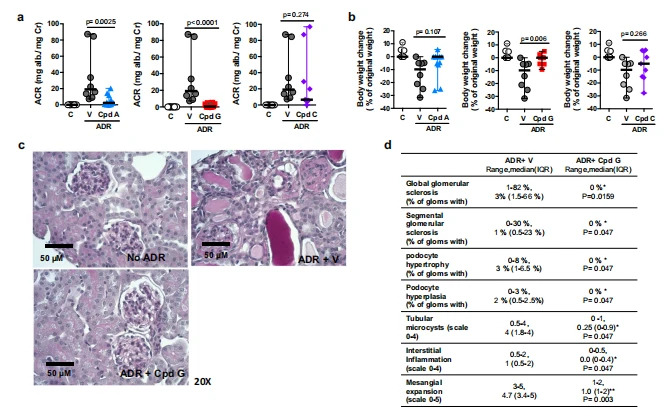
Peb tau ua cov kev tshawb fawb txog koob tshuaj rau kev ntsuam xyuas ua ntej ntawm kev ua tau zoo thiab kev xaiv koob tshuaj rau cov kev tshawb fawb tom ntej. ADR-kev sib tw Balb/c nas tau kho nrog compound A lossis G ntawm qhov ncauj gavage ntawm 30mg/kg lossis 100mg/kg ib zaug hauv ib hnub pib ib hnub tom qab - ADR txhaj. LXR agonist, Cpd C, ntawm ib koob ntawm 10 mg / kg, tau siv los ua qhov sib piv (Cov duab ntxiv 8). Txhawm rau ua rau lub raum raug mob, adriamycin tau muab tshuaj ntawm ib koob ntawm 12mg / kg ntawm lub cev hnyav. Cov zis albumin rau creatinine ratios (ACR) thiab lub cev hnyav tau txiav txim rau hnub 7,14,21, thiab 28 tom qab txhaj tshuaj. ADR-cov nas sib tw tau pom tias muaj proteinuria loj heev thiab lub cev poob ntawm txhua lub sijhawm. ACR qhov tseem ceeb tau txhim kho zoo hauv cov tsiaj kho nrog 30mg / kg / hnub lossis 100mg / kg / hnub ntawm Cpd A lossis 100 mg / kg ntawm Cpd G thiab, kom tsawg dua, los ntawm 30mg / kg ntawm Cpd G. (Cov duab ntxiv. 8). Immunofluorescence microscopy ntawm lub raum cortex seem qhia ADR-vim glomerular degeneration nrog podocyte poob thiab poob ntawm ABC Al qhia. Tag nrho cov teebmeem no raug tiv thaiv los ntawm kev kho mob nrog Cpd G (Ntxiv daim duab 9). Raws li kev tshawb nrhiav, kev kho kom zoo rau cov koob tshuaj Cpd A thiab Cpd G tau txiav txim siab yog 30mg / kg / hnub thiab 100 mg / kg / hnub, raws li. Txoj kev tshawb fawb thib ob tau siv ntau tus tsiaj thiab albumin rau creatinine piv tau txiav txim siab 28 hnub tom qab kev kho mob (Fig. 6a). Raws li cov txiaj ntsig ua ntej, ADR-chaw nas nas (ADR plus V) tsim cov proteinuria hnyav. Kev kho mob nrog Cpd A (ADR ntxiv rau A) (Daim duab 6a, sab laug) thiab, ntau dua, Cpd G (ADR ntxiv G) (Daim duab 6a, nruab nrab), pom 8 thiab 30 npaug qis ACR, raws li, nrog rau qhov nruab nrab IQR ntawm 2.3 (0.3-12mg albumin/mg creatinine) rau Cpd A thiab 0.6 (0. 19 ({43}} mg albumin/mg creatinine). Cov nas uas tau kho nrog LXR agonist Cpd C tau pom qhov txo qis hauv ACR (Fig. 6a, txoj cai). Cpd A (Fig. 6b, sab laug) thiab Cpd G (Fig. 6b, nruab nrab) kuj txo qhov hnyav. Tshaj li 28- hnub tom qab qhov kev sib tw ADR, cov nas hauv pawg tsheb poob txog 30 feem pua ntawm lub cev hnyav. Hauv qhov sib piv, 7 tawm ntawm 10 nas uas tau txais Cpd G pom tias tsis muaj qhov hnyav, tsuas yog me me poob qis dua 5 feem pua rau cov 3 nas ntxiv (Fig. 6b, sab laug). LXR agonist Cpd C tsis muaj txiaj ntsig zoo los tiv thaiv kev poob phaus (Daim duab 6b, txoj cai).

Txij li thaum Cpd G muaj qhov ua tau zoo tshaj plaws los txo cov proteinuria thiab poob phaus, peb tau ua qhov kev soj ntsuam histological ntawm lub raum (Fig. 6c). ADR kev sib tw ua rau muaj kev hloov pauv histological, suav nrog qib siab ntawm focal thiab segmental glomerulosclerosis, nrog rau tubular microcysts, interstitial o, thiab mesangial expansion (Fig. 6d). Cpd G txo qis thoob ntiaj teb thiab segmental glomerulosclerosis, txo podocyte hypertrophy thiab hyperplasia, thiab txo cov tubular microcysts thiab interstitial o (Fig. 6d). Cpd G kuj blunted ADR-induced o, cuam tshuam los ntawm txo IL1 thiab MCP-1 nyob rau hauv lub raum cortex (Ntxiv daim duab 10). Cov ntaub ntawv no qhia tau tias Cpd G muaj txiaj ntsig zoo los txo cov cim ntawm FSGS, tshwj xeeb tshaj yog, los ntawm kev txhim kho hauv ACR thiab tiv thaiv ADR-vim lub cev poob (Daim duab 6).
Effects of Cpd G on plasma parameters and renal and liver lipids. Plasma lipids, hematological parameters, and liver trans-aminase levels were evaluated in all groups after 28 days of treatment. No significant differences in plasma total cholesterol or triglycerides were found. However, sporadically high cholesterol levels (>122mg/dL, 99.5th percentile of the healthy control group) were detected in 50% of ADR-challenged animals that received the vehicle,10% that received Cpd A,33% that received Cpd C, and none that received Cpd G (Supplementary Fig. lla, Supplementary Table 3). Hypercholesterolemia was observed only in mice with particularly severe proteinuria (ACR>15 mg albumin / mg creatinine). Tsis muaj kev hloov pauv hauv cov qib triglyceride tau pom (Cov duab ntxiv 11b). Hematocrit, hemoglobin, suav cov qe ntshav dawb, thiab ALT thiab AST qhov tseem ceeb tau qhia hauv Daim Ntawv Qhia Ntxiv 2. Tsis muaj qhov sib txawv hauv cov ntshav suav. Adriamycin kev kho mob tau nce ALT thiab AST, uas tau txo qis los ntawm Cpd G (Table 4). Tag nrho cov roj cholesterol thiab triglyceride cov ntsiab lus hauv lub raum cortex tseem tsis hloov pauv, txawm hais tias cov ntsiab lus triglyceride ntau dua tau pom nyob rau hauv kwv yees li 30 feem pua ntawm cov tsiaj uas tau txais LXR agonist Cpd C (Supplementary Fig. 11c, d). Lub siab tag nrho thiab esterified cholesterol (CE) qib kuj tseem tsis tau hloov pauv hauv ADR-cov tsiaj sib tw. (Saib ntxiv Fig. lle, f). Qhov txo qis hauv hepatic triglyceride cov ntsiab lus vim qhov kev sib tw ADR tau tawm tsam los ntawm kev kho tshuaj. Cpd A thiab Cpd C, tab sis tsis yog Cpd G, nce hepatic triglyceride cov ntsiab lus vs. kev kho tsheb tswj (Ntxiv daim duab 11g).

Cpd G txo lub raum tsis ua haujlwm hauv tus nas qauv ntawm Alport syndrome. Ntau hom tshuaj steroid-resistant FSGS thiab lwm hom CKD yog tshwm sim los ntawm kev hloov pauv hauv Col IV noob34-36. Peb nyuam qhuav tshaj tawm txo qis ABCAl kev qhia hauv glomeruli los ntawm Col4a3 knockout nas (Col4a3 KO), tus qauv nas ntawm AS13. Col4a3 knockout nas tsis qhia Collagen hom IV. Cov nas no ua rau mob hnyav albuminuria, ntshav siab urea nitrogen (BUN), thiab nce cov ntshav creatinine pib thaum muaj hnub nyoog 4 lub lis piam, nce mus rau theem kawg ntawm lub raum kab mob (ESRD). Tsiaj txhu tuag ntawm lub raum tsis ua haujlwm los ntawm 8 lub lis piam ntawm hnub nyoog 37.
Cpd G (100mg / kg), lossis tsheb, tau muab rau Col4a3 KO nas txhua hnub, los ntawm qhov ncauj gavage, pib thaum muaj hnub nyoog 4 lub lis piam thaum cov nas thawj zaug pom muaj cov tsos mob ntawm lub raum tsis txaus. Kev kho mob tau txuas ntxiv rau 4 lub lis piam, thiab cov nas muaj sia nyob tau muab txi rau thaum muaj hnub nyoog 8 lub lis piam. Albuminuria (Fig. 7a), ntshav creatinine (Fig. 7b), ntshav urea nitrogen (Fig. 7c), thiab qhov hnyav poob (Fig. 7d) tau txo qis hauv Col4a3 KO nas kho nrog Cpd G. Hauv kev sib piv nrog cov tsiaj uas tau txais ramipril los ntawm kev kawm ua ntej nrog kev sib npaug ntawm cov qauv tsim38, albuminuria tau txo qis hauv cov tsiaj uas tau txais Cpd G thiab cov nyhuv ntawm Cpd G ntawm BUN thiab cov ntshav creatinine tsis qis dua rau ramipril (Supplementary Fig.12). Kev soj ntsuam histological ntawm lub raum tau pom tsawg dua mesangial expansion hauv Cpd G-kho nas (Fig. 7e, f). Cpd G tsis muaj kev cuam tshuam rau cov roj cholesterol hauv cov ntshav (Cov Lus Qhia Ntxiv 13a) tab sis nyiam txo cov ntshav triglycerides (Ntxiv Fig.13b). Cpd G tsis cuam tshuam rau tag nrho cov roj (cholesterol) lossis triglyceride cov ntsiab lus hauv lub raum cortex (Supplementary Fig.13c,d).
Txhawm rau tshawb xyuas seb Cpd G tuaj yeem muaj txiaj ntsig zoo rau hauv lub raum tsis ua haujlwm, peb tau ua txoj kev tshawb fawb txog kev tuag uas tau pib kho nrog Cpd G lossis placebo thaum muaj hnub nyoog 6 lub lis piam, ib lub sijhawm thaum lub raum tsis ua haujlwm tseem ceeb tau tshwm sim. Peb pom tias Cpd G txo cov neeg tuag hauv Col4a3 KO nas, ua rau lub neej nce ntxiv ntawm kwv yees li 15 feem pua piv rau kev tswj hwm (Fig.7g).
Cpd G txo lub raum cov roj cholesterol cov ntsiab lus hauv ob hom kab mob. Glomerular cholesterol thiab lipid tsub zuj zuj yog paub zoo tias muaj feem xyuam nrog kev mob raum kab mob 7-10, 12-14 Lub raum cortex los ntawm cov nas uas tau txais tsheb tom qab ADR kev sib tw, tab sis tsis yog cov uas tau txais Cpd G, pom qhov tso tawm ntawm lipid droplets tshwj xeeb tshaj yog nyob rau hauv glomeruli, thiab ib qho tseem ceeb nce nyob rau hauv cov cholesterol ester cov ntsiab lus (Fig. 8a, b). Cov roj cholesterol ester cov ntsiab lus muaj zog cuam tshuam nrog albuminuria (Fig. 8c). Cpd G kuj tseem txo cov roj cholesterol cov ntsiab lus hauv ob lub raum ntawm Col4a3 KO nas (Fig. 8d). Txawm hais tias qhov txo qis hauv cov roj cholesterol ester hauv lub raum, tsis muaj kev hloov pauv hauv cov roj cholesterol hauv cov nas Col4a3 thiab tsuas yog nyob hauv kwv yees li 50 feem pua ntawm ADR nas (Ntxiv Fig. lla thiab Supplementary Fig. 13a). Cov ntaub ntawv no qhia tias Cpd G tuaj yeem tiv thaiv los ntawm kev txo cov roj cholesterol thiab cov ntsiab lus lipid hauv ob lub raum.